

When he called us, our client wasn't looking for a bigger version of the 12-unit apartment complex he'd just agreed to sell. He was looking for more doors, stronger cash flow, and a way to put his equity to work harder without piling on new debt. He'd spent years getting that property into great shape, more of a townhome community than a typical apartment building, and when a strong offer finally came in, he took it and set out to roll the proceeds into something bigger through a 1031 exchange, the tool that lets real estate investors defer capital gains tax when they trade one investment property for another. Finding the next property, he assumed, would be the easy part. It wasn't. He spent weeks looking for a replacement property in his size range and price point and kept coming up empty.
That gap is where the deal turned into something more interesting than a standard exchange. Instead of chasing a like-for-like replacement that didn't really exist in his market, he bought a rundown 20-unit property and used his exchange funds to fix it up before he ever took title. We structured this one as an improvement exchange, also called a build-to-suit or construction exchange, and it's still one of the better examples we point to when investors ask what this strategy can actually do.
Key Takeaways
- One client used an improvement exchange to trade a well-maintained 12-unit property for a rundown 20-unit property, using exchange funds to renovate it before taking title.
- He ended up with the same equity and debt he started with, but 8 more units and rents up roughly 50% over the original property.
- The Exchange Accommodation Titleholder (EAT) held title while exchange funds paid contractor draws — the same mechanics used in any improvement exchange.
- Only capital improvements qualify for exchange funds — not furniture, fixtures, or equipment.
- Results vary by deal, market, and renovation scope — this case study shows what’s possible, not a guaranteed outcome.
The Property: A 12-Unit Community That Had Run Its Course
Our client's 12-unit property wasn't a problem child. He'd owned it for years, kept up with maintenance, and updated it as things wore out, so it showed well and rented well. That's exactly why the offer he received was strong enough to act on. He wasn't chasing a fire sale or trying to escape a headache. He already knew what he wanted next: more doors, more income streams, and less exposure if one tenant left or one unit sat vacant for a month.
So he did what most investors do first. He went looking for something roughly the same size, roughly the same price, in reasonably similar shape. That search is where things stalled.
The Problem: Where Do You Go When Nothing Comparable Exists
Smaller apartment complexes in the 12 to 25-unit range occupy an odd spot in the market. Properties at that scale and price point tend to be run down almost by default, because owners who invest in upkeep usually aren't the ones selling cheap, and owners who are selling cheap usually haven't invested in upkeep. Meanwhile, new multifamily construction skips right past that range. Developers build in the hundreds of units now, not the 15 or 20-unit communities our client wanted. He was caught between properties that needed too much work and new builds that didn't exist at his scale.
Nowhere, if you're only looking at what's already finished. Something has to give.
This is one of the most common walls multifamily investors hit mid-exchange. They budget for a straight swap, assume a comparable property is out there somewhere, and then spend their 45-day identification window watching that assumption fall apart. The properties that fit the price either need a full renovation or they're already gone.
The Decision: Why an Improvement Exchange Made More Sense Than a Straight Swap
At some point in that search, our client stopped asking "what can I buy that's already finished" and started asking "what could I buy and finish myself." That's the moment an improvement exchange stops being a technical term and starts being a real option. Rather than keep hunting for a property that matched his old one unit for unit, he pivoted to buying a 20-unit complex that fit his price but needed serious work: dated kitchens, aging mechanical systems, the kind of deferred maintenance list you'd expect on a property that had been coasting on minimum upkeep for years.
Under a standard deferred exchange, buying a property in that condition with no funded plan to fix it would have been a mistake. He'd have been stuck holding a distressed asset with no tax-advantaged way to bring it up to standard. An improvement exchange changed the math entirely, because it let him use exchange funds not just to acquire the property, but to fund renovation on it before he ever took ownership himself.
How We Structured the Deal
In an improvement exchange, the qualified intermediary sets up an Exchange Accommodation Titleholder, or EAT, a special-purpose LLC that temporarily holds title to the replacement property while the exchange funds pay for construction. The IRS requires this because it won't let you use 1031 dollars to improve a property you already own outright. Somebody neutral has to hold title while the work gets done, and that somebody is the EAT.
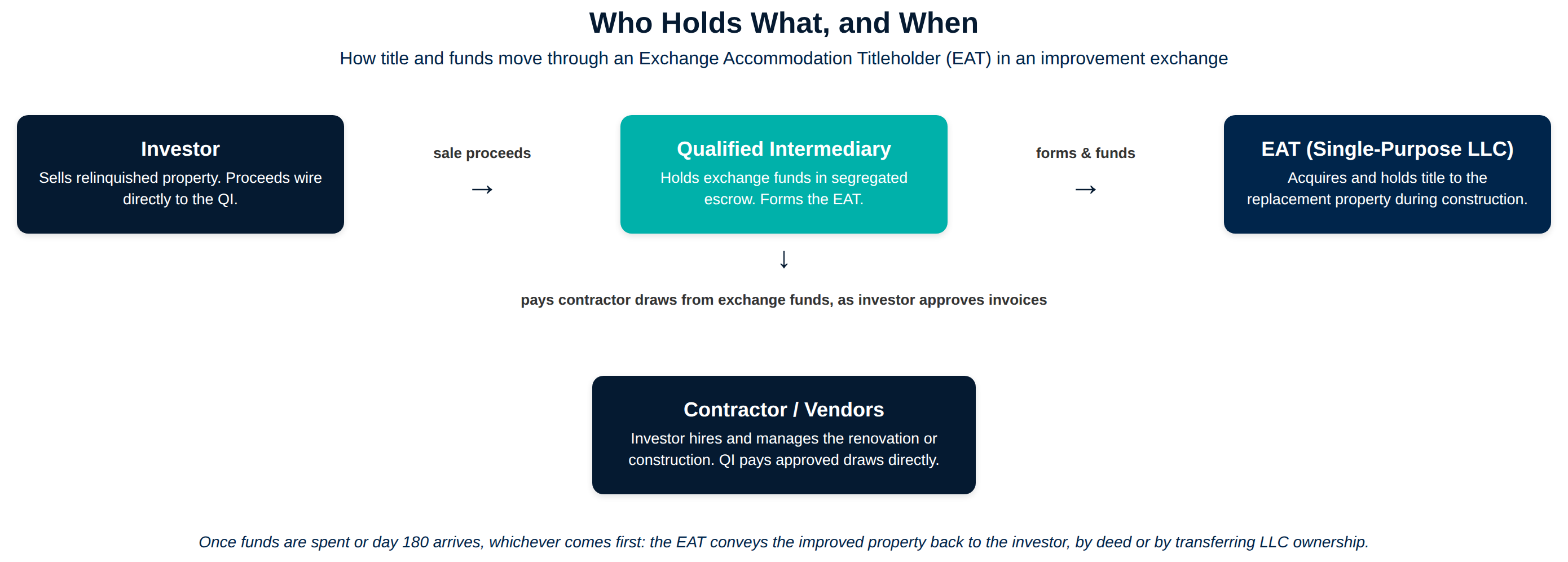
For our client, that meant his exchange funds went to work in two stages. First, the EAT acquired the 20-unit property on his behalf. Then, as the renovation progressed, he approved invoices from his contractors and vendors, and the EAT paid them out of the remaining exchange funds, much like a draw request on a construction loan. He managed the renovation day to day. We managed the tax-compliant plumbing behind it. This general structure, holding title through a Qualified Exchange Accommodation Arrangement (QEAA), follows the safe harbor the IRS laid out in Revenue Procedure 2000-37, and it operates within the broader like-kind exchange rules under Treasury Regulations Section 1.1031. It's the same basic titleholder mechanism used in reverse exchanges, just applied to funding construction instead of parking a property before a sale closes.
Not every qualified intermediary is set up to run this structure; managing the EAT paperwork correctly takes a legal background some QIs would rather not take on. WealthBuilder 1031, a nationwide qualified intermediary led by Chris Peterson, a licensed Texas real estate attorney, takes on improvement and reverse exchanges as a regular part of the practice. We hold exchange funds in segregated escrow accounts, and we're insured and bonded.
Inside the Renovation: Racing the Clock on a 20-Unit Turnaround
Once the EAT had the 20-unit property under its umbrella, the clock became the whole story. Exchangers generally have 180 days from the closing of the relinquished property to complete the funded portion of construction. The deadline doesn't move. Not for weather, contractor delays, or supply chain problems. Our client had already told us, within his 45-day identification window, the general scope of the improvements he planned to make. We don't need paint colors or cabinet finishes at that stage. We need to know paint and cabinets are happening.
The renovation touched pretty much everything you'd expect on a tired 20-unit property: units brought up to a consistent standard, common areas refreshed, systems that were past their useful life replaced. One detail that catches a lot of investors off guard is what exchange funds can and can't pay for. They cover capital improvements, meaning things that get physically added to the real property, but they don't cover furniture, fixtures, and equipment. New kitchen counters and flooring qualify. New living room furniture doesn't. Our client's contractor worked from a scope tied tightly to capital improvements, which kept the draws clean and kept us from having to untangle an ineligible expense mid-exchange.
None of that is glamorous. It's also exactly where exchanges go sideways if nobody's tracking the details.
By the time the 180-day window closed, the exchange-funded portion of the renovation was done, and title moved from the EAT back to our client. He walked away owning a fully renovated 20-unit asset instead of the distressed property he'd bought.
Before and After: What the Numbers Looked Like
| Metric | Original 12-Unit Property | 20-Unit Property at Acquisition | 20-Unit Property After Renovation |
|---|---|---|---|
| Unit count | 12 | 20 | 20 |
| Condition | Well-maintained, updated over years of ownership | Rundown, deferred maintenance throughout | Fully renovated to a consistent standard |
| Rent roll | Baseline | Unchanged from prior ownership, below market | Up roughly 50% over the original 12-unit baseline |
| Equity and debt | Client's existing equity and debt load | Same equity and debt rolled forward, no new outside capital | Same equity and debt load carried into 20 units |
| Capital gains tax | Deferred through the 1031 exchange | Deferred | Deferred |
The Outcome: More Doors, Higher Rents, Same Money at Work
The baseline benefit of any 1031 exchange is deferral, and our client got that. He didn't write a check to the IRS on the sale of his original property. But the improvement exchange structure gave him something a standard deferred exchange into a finished property couldn't have: it let him create value instead of just transferring it.
He rolled essentially the same equity and debt he already had into the new property. No new outside capital came into the deal. Yet because he ended up with more units, all freshly renovated, with rents up roughly 50%, his cash flow on that same investment base jumped substantially. That's the piece worth studying. He didn't need new capital to grow his portfolio. He needed a structure that let his existing capital do more.
We want to be direct about what this case study is and isn't. This was one investor's outcome in his specific market, with his specific renovation budget and his specific rent comps. It's not a promise that every improvement exchange produces a 50% rent increase or doubles a unit count. Every deal depends on the property, the renovation scope, local rental demand, and how tightly the construction budget gets managed. What it does show is the range of outcomes this strategy makes possible when the pieces line up, and that's worth taking seriously if you're sitting on a property that's outgrown its usefulness to you. Consult your tax advisor for guidance specific to your situation before you commit to a structure like this one.
What If Your Deal Doesn't Look Like His?
Investors hear this case study and immediately start listing reasons their own situation is different. Some of those reservations are worth addressing directly.
"My property isn't run down enough to justify this."
You don't need a distressed property to consider an improvement exchange. This strategy applies just as well when you've found a great location or a strong-performing property that's simply below the value of what you sold, and you want to use the difference to add value through capital improvements rather than lose it to taxable boot.
"I don't have renovation experience."
You don't have to manage the renovation solo. Plenty of clients hire a general contractor to run the project day to day while they approve draws and stay focused on the numbers, and a good realtor or QI can point you toward vetted contractors who've handled improvement exchanges before.
"What if my numbers don't work out as well as this investor's did?"
They might not, and that's fine, because deferral is still the baseline win even without a dramatic rent increase. Any value you add through capital improvements strengthens your position beyond a straight swap, even in markets where rent growth is more modest than what this client saw.
Is This Strategy Right for Your Portfolio?
An improvement exchange isn't the right fit for every investor, and it's worth being honest about who it does fit.
This is a good fit if:
- You can look at a distressed or underpriced property and see upside where other buyers see a headache
- You're comfortable overseeing a renovation on a fixed deadline, whether personally or through a general contractor
- You're chasing more doors, more cash flow, or a stronger asset, not just a mirror image of what you sold
- You have or can arrange renovation funding beyond your leftover exchange dollars if the project runs bigger than your 1031 funds cover
- You want to put existing equity to work harder without bringing in new outside capital
This probably isn't the right fit if:
- You want a turnkey, already-stabilized property with no construction risk
- You're not able to move quickly on identification and construction within the 180-day exchange period
- Your timeline or personal bandwidth can't absorb the demands of managing contractors and draw requests
- You haven't found a replacement property yet and are running low on time in your exchange window
Talk to your tax advisor and an experienced qualified intermediary before you commit, since the timelines and funding rules have real teeth and mistakes here get expensive fast.
Frequently Asked Questions
What is an improvement exchange?
An improvement exchange, also called a build-to-suit or construction exchange, lets you use 1031 exchange funds to both acquire a replacement property and fund capital improvements or new construction on it, all within your exchange period. It's one of four recognized exchange types, alongside simultaneous, deferred, and reverse exchanges.
How is an improvement exchange different from a reverse exchange?
Both use an Exchange Accommodation Titleholder to hold title temporarily, but a reverse exchange parks a property you're buying before you've sold your old one, while an improvement exchange uses that same titleholder structure to fund construction on a property you're acquiring as part of a standard sale-then-buy sequence. Some deals combine elements of both.
How long do I have to complete the renovation?
You have until the end of your 180-day exchange period, or until your exchange funds run out, whichever comes first. You don't need to finish the entire project by then if you're using outside financing for a larger build, but any work paid for with 1031 funds has to be completed within that window.
What can exchange funds pay for during renovation?
Exchange funds cover capital improvements added directly to the real property, things like new roofing, updated units, mechanical systems, or new construction. They can't pay for furniture, fixtures, and equipment, so new appliances built into cabinetry generally qualify while freestanding furniture doesn't.
Who holds title to the property during construction?
The Exchange Accommodation Titleholder, an LLC set up specifically for your transaction, holds title while renovation work is underway using exchange funds. Once the 180-day period ends or funds are exhausted, title transfers to you, either by deed or by transferring ownership of the LLC itself.
What happens if my renovation costs more than my leftover exchange funds?
You bring in your own capital or a construction loan to cover the difference. It's common for improvement exchange budgets to exceed available 1031 funds, and lenders can be brought in alongside the EAT structure once they understand how the titleholder arrangement works.
How much does WealthBuilder 1031 charge for an improvement exchange?
Our fee for a reverse or improvement exchange is a flat $6,500, which reflects the extra legal and administrative work involved in setting up and managing the EAT. That's different from the $1,000 fee we charge for a standard deferred exchange with no titleholder involved.
Does my replacement property have to be similar to what I sold?
No, the like-kind requirement for real estate is much broader than most investors expect. You can exchange a small multifamily property for a larger one, for retail, for land, or for almost any other real estate held for investment or business use, as long as you follow the exchange rules and timelines.
Ready to Explore an Improvement Exchange?
Our client's deal is a good example of what happens when you stop looking for an identical replacement property and start looking at what you can build instead. An improvement exchange gave him a way around a real gap in his market, and it let him turn 12 aging units into 20 renovated ones without bringing in new outside money. Your numbers, your market, and your renovation scope will look different, but the underlying structure works the same way whether you're improving five units or fifty. If you're weighing a similar move, our improvement exchange case study walks through the mechanics in more detail, including timelines, the role of the Exchange Accommodation Titleholder, and what documentation you'll need along the way.
If you're planning an improvement exchange, WealthBuilder 1031 can help. We're a nationwide Qualified Intermediary experienced in improvement and reverse exchanges. Call 888-508-1901 or visit WealthBuilder1031.com to get started.
This article is for educational purposes only and does not constitute legal or tax advice. Consult your tax advisor or attorney regarding your specific situation. Case details are from an actual WealthBuilder 1031 client transaction, shared with permission and general details adjusted for privacy; individual results vary based on market conditions and each investor's specific situation.
Disclaimer: This content is for informational purposes only and does not constitute legal or tax advice. Consult your tax advisor or attorney for advice specific to your situation.

Chris Peterson — Texas Licensed Attorney & Founder, WealthBuilder 1031
Chris is the Owner and President of WealthBuilder 1031 and a licensed Texas attorney. He graduated from Wheaton College and the University of Texas School of Law and speaks regularly to realtors, accountants, and title companies about 1031 exchanges. Learn more →
Have Questions?
Chat with one of our team members to see if a 1031 Exchange is right for you, (without committing to anything).
Video Resources

Case Studies
August 14, 2026
Reverse Improvement Exchange: Combining 1031 Strategies
Most investors who call us about advanced 1031 strategies are wrestling with one complication, not two. Every so often, someone finds a replacement property that
Read More

August 11, 2026
How Realtors Add Value in a 1031 Improvement Exchange
The call almost always starts the same way. A client sold a property, the exchange funds are sitting with the qualified intermediary, and nothing on
Read More

August 4, 2026
Can You Do a 1031 Exchange on a Fix and Flip? Probably Not
If you searched "1031 exchange fix and flip," you're probably staring at a property you just renovated and wondering if you can defer the tax
Read More
Get Started Today
It is easy to get started on your exchange. You can either call our office directly at 888-508-1901, or you can fill out our Start Your Exchange form.
Start Your Exchange