

Most investors who call us about advanced 1031 strategies are wrestling with one complication, not two. Every so often, someone finds a replacement property that only comes around once, and it needs real work before it's rentable or sellable. The catch: they haven't sold their current property yet, and the seller of the new building won't wait six months for them to find a buyer. That combination, buying first and renovating before closing, is exactly what a reverse improvement exchange exists to solve. If you already understand a standard reverse exchange and a standard improvement exchange on their own, this is where those two strategies meet inside one transaction.
Key Takeaways
- A reverse improvement exchange combines two strategies: buying the replacement property before you sell (reverse), and using exchange funds to improve it before you take title (improvement).
- It solves a specific problem — a replacement property you need to buy fast that also needs work before it reflects full exchange value.
- The EAT holds title through both the sale-timing wait and the construction period, which is why this structure needs more coordination than either strategy alone.
- The same 45-day and 180-day deadlines apply — the combined structure doesn’t extend either one.
- This is the most complex and least common exchange structure WealthBuilder 1031 handles, priced at the same flat $6,500 fee as a standalone improvement or reverse exchange.
Quick Refresher: Reverse Exchange vs. Improvement Exchange
The order of operations is completely different between the two, and mixing them up is the fastest way to blow a filing.
In a standard reverse exchange, you buy the replacement property first, before you sell the property you're giving up. The IRS won't let you hold title to both properties at the same time and still get 1031 treatment, so your Qualified Intermediary sets up a special entity called an Exchange Accommodation Titleholder, or EAT, under the safe harbor described in Revenue Procedure 2000-37. The EAT is a single-purpose LLC that temporarily holds title to the new property while you sell your old one. Once your relinquished property sells, usually within 180 days, the EAT transfers the replacement property into your name and the exchange closes out.
An improvement exchange runs in the opposite order. You sell your relinquished property first, just like in a typical deferred exchange under Treasury Regulations Section 1.1031. The difference shows up on the replacement side: instead of buying a finished property outright, the EAT holds title while contractors make capital improvements to it, paid for with your exchange funds through a construction escrow the EAT administers. Once the funds are spent or the 180-day window closes, whichever comes first, the EAT conveys the improved property to you. Buy before you sell, and you've moved into a different structure entirely, the one we're covering here.
A Deal That Needed Both
One scenario we see play out, a composite drawn from clients we've represented rather than a single case, shows exactly why this structure exists.
She called with a ticking clock, not a wish list. The seller wanted to close in three weeks on a sixteen-unit multifamily building in a submarket where inventory barely moves, and if she couldn't hit that timeline, someone else would get the deal. Location was right, price was fair, and the discount reflected a dated unit mix with rents sitting well below market. Her own rental property, the one she planned to sell to fund the purchase, hadn't even hit the market yet.
A standard improvement exchange wouldn't work, because that structure requires selling first, and she didn't have three weeks to find a buyer, get to contract, and close. A standard reverse exchange wouldn't fully solve it either, because the sixteen-unit building needed renovation dollars to reach the rents that made the purchase price work in the first place. She needed to buy now, on the seller's timeline, and improve the property before her exchange closed, all while her relinquished property was still sitting on the market.
We set up the EAT to take title to the sixteen-unit property at closing, using her exchange funds along with a short-term loan we helped her coordinate through her existing lender.
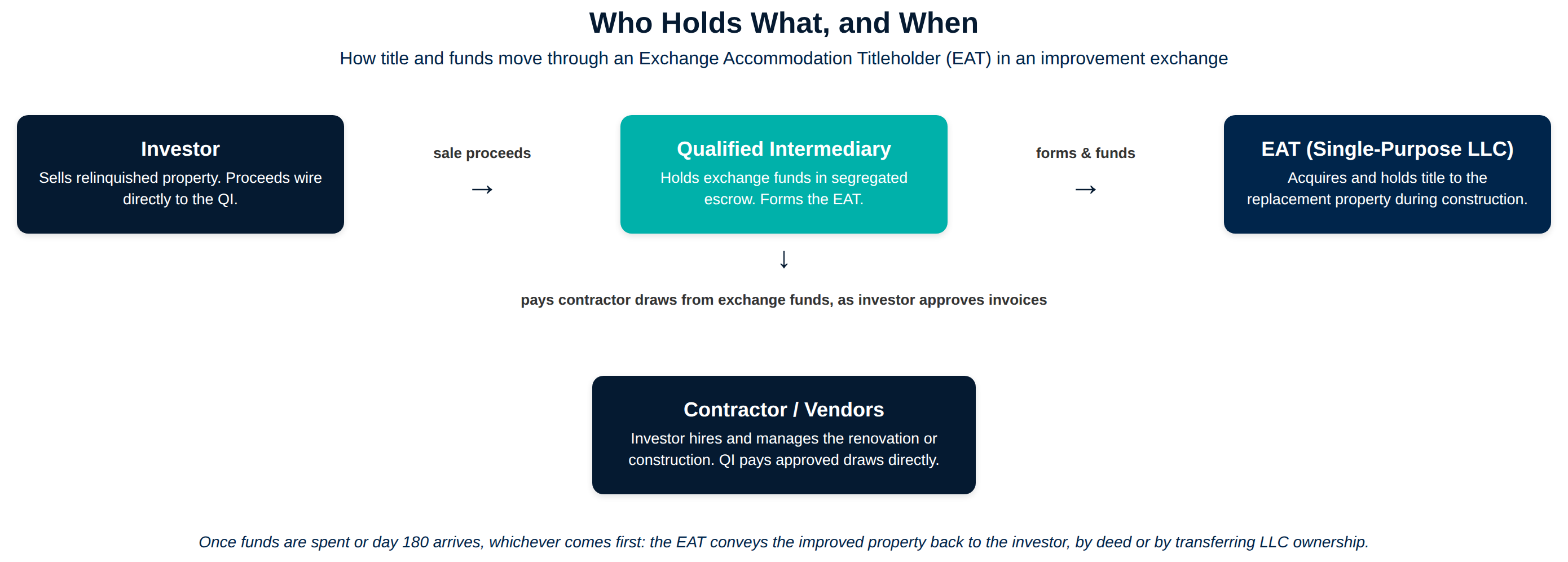
Over the following four months, the EAT held title while she managed a full unit-mix renovation, funded through a construction escrow account tied to the exchange. Her old rental sold in month three. Once the sale closed and the renovation draws were substantially complete, the EAT deeded the improved property into her name, and the exchange closed inside the 180-day window with room to spare. Her adjusted basis carried forward from the relinquished property plus the cost of the improvements, and she deferred the full gain on the sale of her old rental. Consult your tax advisor for guidance specific to your situation, since basis calculations vary by deal.
Running two clocks, a sale timeline and a construction timeline, inside one exchange takes real coordination. One slip stalls everything. We've walked clients through exactly this sequencing more than once, and the deals that go smoothly are the ones where the QI, the lender, and the contractor all work off the same calendar from day one.
How the EAT's Role Changes in a Combined Structure
In a combined structure, the EAT does more work and holds title for longer, and that's exactly why this deal takes more coordination than either structure runs on its own.
The EAT takes title to the replacement property right at the start, the same way it would in a straightforward reverse exchange, operating under the Qualified Exchange Accommodation Arrangement, or QEAA, that Revenue Procedure 2000-37 lays out. Instead of just parking the property until the relinquished property sells, the EAT also manages the improvement side of things. Exchange funds flow through the EAT to pay contractors, and the renovation happens while the EAT still holds title, the same mechanics as a standalone improvement exchange. The two structures stack on top of each other rather than run one after another.
Not every dollar spent during renovation counts toward your exchange. The IRS only treats capital improvements, things permanently added to the real property like a new roof, updated electrical, or a rebuilt unit interior, as eligible replacement value. No do-overs on this one. Furniture, fixtures, and equipment don't qualify, so a client renovating a property can't use exchange funds to furnish it once the work wraps up. We've had clients ask whether a new refrigerator counts — built into the unit, usually yes; the one they were eyeing at the appliance outlet down the road to replace it later, no. That distinction trips people up more than almost anything else in an improvement exchange.
Once the investor sells the relinquished property and the improvements are substantially complete, or the clock runs out, whichever happens first, the EAT conveys the improved replacement property into the investor's name and the exchange wraps up. Your Qualified Intermediary needs to track two moving pieces at once here, the sale timeline and the construction timeline, not just one. Losing track of either one is how exchanges fail.
What This Means for Your Timeline and Budget
The deadlines don't shift just because the structure gets more complicated, and that's the part investors underestimate most.
You still have 45 days from the transfer of the replacement property to identify the property you're relinquishing, using one of the standard identification rules (the three-property rule, the 200% rule, or the 95% rule), and you still have 180 days total to finish the entire exchange: sale, improvements, and title transfer all included.
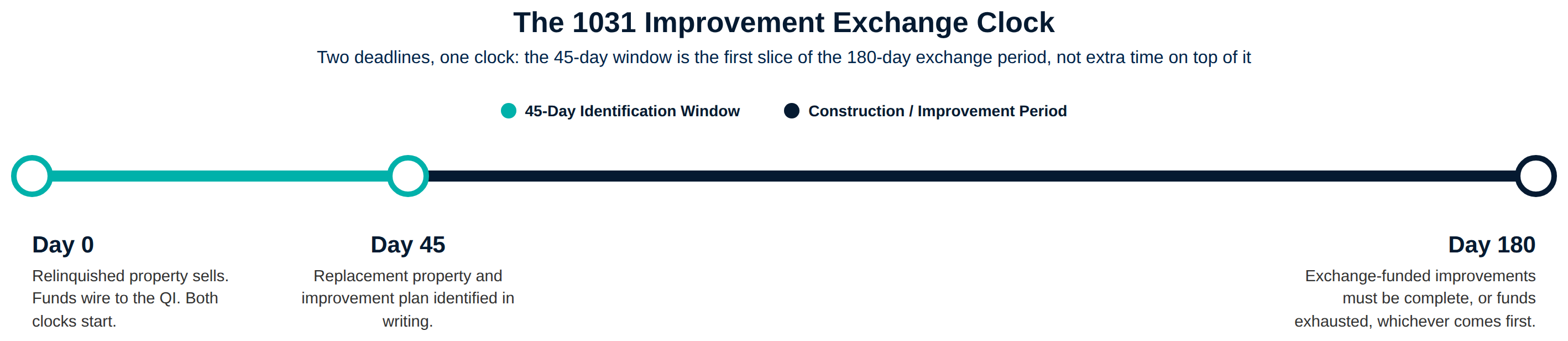
What changes is how much has to line up inside that window. Financing on the new property, your contractor's construction schedule, and your ability to sell the old property all have to move in sync, because a delay in any one of them threatens the whole exchange.
Deferred exchanges make up roughly 94% of all 1031 exchanges nationwide. Reverse and improvement exchanges are far less common on their own, and the combined reverse improvement version is rarer still. That rarity is exactly why it demands a Qualified Intermediary with actual experience running one, not just reading about one.
On the budget side, WealthBuilder 1031 charges a flat $6,500 for reverse and improvement exchanges, including the combined reverse improvement structure. That's a different fee than the $1,000 flat rate we charge for a standard deferred or simultaneous exchange, and the difference reflects the real work involved: setting up and administering the EAT, managing exchange funds through a segregated construction escrow, coordinating with your lender, and handling the unwind once everything is ready to convey. Given how many parties need to stay coordinated on a deal like this, an experienced QI isn't optional. It's the difference between a clean closing and a blown exchange that leaves you owing capital gains tax you were trying to defer.
Improvement Exchange vs. Reverse Exchange vs. Combined Reverse-Improvement Exchange
| Structure | Problem It Solves | Who Holds Title | Typical Complexity | Typical WB1031 Fee |
|---|---|---|---|---|
| Improvement Exchange | You've sold, but can't find a replacement property that reflects full exchange value without upgrades | EAT holds the replacement property during construction, then conveys it to you | Moderate: one clock, one property in transition | $6,500 flat |
| Reverse Exchange | You need to buy the replacement property before your relinquished property sells | EAT holds the replacement property until your sale closes | Moderate to high: financing and lender coordination | $6,500 flat |
| Combined Reverse-Improvement Exchange | You need to buy before selling, and the property needs work before it's exchange-ready | EAT holds the replacement property through both the sale wait and the construction period | High: two clocks running at the same time | $6,500 flat |
A standard deferred exchange, where you sell and then buy within the 180-day window without needing an EAT at all, costs $1,000 flat with WealthBuilder 1031.
Is This Right for You?
This is a good fit if:
- You've found, or expect to find, a replacement property you can't afford to lose, and the seller won't wait for your sale to close first
- The replacement property needs real capital improvements before it reflects full exchange value or generates the returns you need
- Your relinquished property hasn't sold yet, but you're confident it will move within the 180-day window
- You have financing lined up, or a lender willing to work with an EAT holding title temporarily
- You're working with a Qualified Intermediary who has actually run a combined reverse-improvement deal before, not just a standard exchange
This probably isn't the right fit if:
- You have flexibility on timing and could simply sell first, then run a standard improvement exchange
- The replacement property is move-in ready and doesn't need capital improvements
- Your relinquished property is difficult to sell or priced above market, which puts the 180-day clock at real risk
- You're not prepared for the added coordination between your lender, contractor, and QI, or the flat $6,500 fee feels out of proportion to the deal size
- Your current QI has never structured a reverse exchange or an improvement exchange individually, let alone combined
Frequently Asked Questions
Is a reverse improvement exchange too complicated to actually work?
No, but it only works with the right sequencing and an experienced team. The IRS has allowed this structure through the QEAA safe harbor in Revenue Procedure 2000-37 for over two decades, and it works when the sale timeline and the construction timeline stay on one calendar from the start.
Won't this cost a lot more than a standard exchange?
Yes, and it should. WealthBuilder 1031 charges a flat $6,500 for a combined reverse-improvement exchange, compared to $1,000 for a standard deferred exchange, because the EAT setup, segregated escrow administration, and dual-timeline coordination require substantially more work. That fee is small next to the capital gains tax you'd owe if a rushed or mismanaged exchange failed altogether.
What if my QI has never done one of these before?
Ask before you hire them. Improvement and reverse exchanges together make up a small fraction of all 1031 exchanges nationwide, and administering the EAT correctly takes legal groundwork that not every QI has built out, so some decline combined structures outright. We structure these deals regularly and can walk you through our process before you commit.
Can I use exchange funds to furnish the replacement property once renovations are done?
No. Only capital improvements permanently added to the real property qualify, things like a new roof, updated systems, or structural work. Furniture, fixtures, and equipment don't count toward your exchange value, even if you bought them for the same property.
How long does the EAT hold title in a combined structure?
Until your relinquished property sells and the exchange-funded improvements are substantially complete, or until the 180-day deadline arrives, whichever happens first. Both the sale and the construction have to land inside that same window.
Will my lender have a problem with the EAT holding title?
Lenders sometimes have questions the first time they see it, since the EAT technically borrows on the deal during the exchange. We explain how their collateral position stays functionally identical to a normal loan, and once they see the note, guaranty, and deed of trust structure, most lenders get comfortable quickly.
Do I still have to identify a replacement property within 45 days?
Yes. The 45-day identification window and the 180-day completion deadline apply the same way they do in any 1031 exchange, and you'll identify under one of the standard rules: the three-property rule, the 200% rule, or the 95% rule. The combined structure doesn't extend either deadline.
Getting the Structure Right From Day One
A reverse improvement exchange asks a lot of everyone involved: your QI, your lender, your contractor, and your closing team, all working against the same 180-day clock. For the investor who's found a property worth the extra complexity, it's a workable path to buy now, improve it right, and still defer taxes on the sale of the old property.
WealthBuilder 1031, a nationwide qualified intermediary led by Chris Peterson, a licensed Texas real estate attorney, holds every client's exchange funds in a segregated escrow account and carries the insurance and bonding serious investors expect before handing control of a transaction this complex to a third party. Attorney ownership means the person structuring your EAT understands the legal exposure on both sides of the deal, not just the paperwork behind it.
If you're considering a reverse or improvement exchange, or you suspect you need both at once, WealthBuilder 1031 can help. Call 888-508-1901 or visit WealthBuilder1031.com to get started.
This article is for educational purposes only and does not constitute legal or tax advice. Consult your tax advisor or attorney regarding your specific situation.
Disclaimer: This content is for informational purposes only and does not constitute legal or tax advice. Consult your tax advisor or attorney for advice specific to your situation.

Chris Peterson — Texas Licensed Attorney & Founder, WealthBuilder 1031
Chris is the Owner and President of WealthBuilder 1031 and a licensed Texas attorney. He graduated from Wheaton College and the University of Texas School of Law and speaks regularly to realtors, accountants, and title companies about 1031 exchanges. Learn more →
Have Questions?
Chat with one of our team members to see if a 1031 Exchange is right for you, (without committing to anything).
Video Resources

Case Studies

August 11, 2026
How Realtors Add Value in a 1031 Improvement Exchange
The call almost always starts the same way. A client sold a property, the exchange funds are sitting with the qualified intermediary, and nothing on
Read More
August 7, 2026
Case Study: Turning 12 Units Into 20 With an Improvement Exchange
When he called us, our client wasn't looking for a bigger version of the 12-unit apartment complex he'd just agreed to sell. He was looking
Read More

August 4, 2026
Can You Do a 1031 Exchange on a Fix and Flip? Probably Not
If you searched "1031 exchange fix and flip," you're probably staring at a property you just renovated and wondering if you can defer the tax
Read More
Get Started Today
It is easy to get started on your exchange. You can either call our office directly at 888-508-1901, or you can fill out our Start Your Exchange form.
Start Your Exchange