
If your title company, lender, or attorney just mentioned an "exchange accommodation titleholder" and your eyes glazed over, you're not alone. Most investors go their whole careers without hearing the term, because it only shows up in one corner of 1031 planning: improvement exchanges and reverse exchanges. The question we hear on almost every call is the same one: who actually owns the property while it's being built?
An exchange accommodation titleholder, or EAT, is the entity that temporarily holds title to your replacement property while contractors do the work you're paying for with your 1031 exchange funds. It sounds like a formality. It isn't. Understanding what this entity does, and why the IRS requires it, is the difference between running a construction project on your own terms and scrambling to explain your structure to a confused lender three weeks before closing.
Key Takeaways
- An EAT is a single-purpose LLC that temporarily holds title to your replacement property so exchange funds can pay for construction before you own it outright.
- The structure comes from Revenue Procedure 2000-37, the IRS safe harbor that created the Qualified Exchange Accommodation Arrangement (QEAA).
- The same 45-day identification and 180-day completion deadlines apply — there’s no separate 12-month rule for improvement exchanges.
- Exchange funds can pay for capital improvements, not furniture, fixtures, or equipment (FF&E).
- When the exchange closes, title transfers to you either by deed or by taking over ownership of the EAT LLC itself.
What an Exchange Accommodation Titleholder Actually Does
An exchange accommodation titleholder is a legal entity, almost always a single-purpose LLC, that holds legal title to your replacement property so you can use 1031 exchange funds to build or renovate before you own the property outright. The IRS won't let you use exchange funds to improve a property you already own in your own name; you have to be improving property that's still "held for exchange." That created a real problem for investors until 2000, when the IRS issued Revenue Procedure 2000-37, the safe harbor that created the EAT and the broader structure known as a Qualified Exchange Accommodation Arrangement, or QEAA. Without that safe harbor, improvement exchanges the way we structure them today wouldn't exist.
We think of the EAT as a stand-in, not a stranger. It keeps your property inside the exchange, technically speaking, long enough for your construction dollars to count toward your replacement value under Treasury Regulations Section 1.1031. You sell your relinquished property first, and you need to have already hired your qualified intermediary and signed exchange paperwork before that sale closes. Your sale proceeds wire straight to your QI, and that wire starts both your 45-day identification clock and your 180-day exchange completion clock at the same moment. The 45 days isn't extra time tacked onto the 180. It's the first slice of it.
Within that window, you give your QI a written list of potential replacement properties under one of three identification rules, the Three-Property Rule, the 200% Rule, or the 95% Rule, along with a general description of the improvements you plan to make. You don't need granular specs like paint colors or cabinet hardware — a general contractor's scope of work is plenty. A one-page bid list from your GC is often all it takes.
Why the QI Sets Up a Single-Purpose LLC to Hold Title
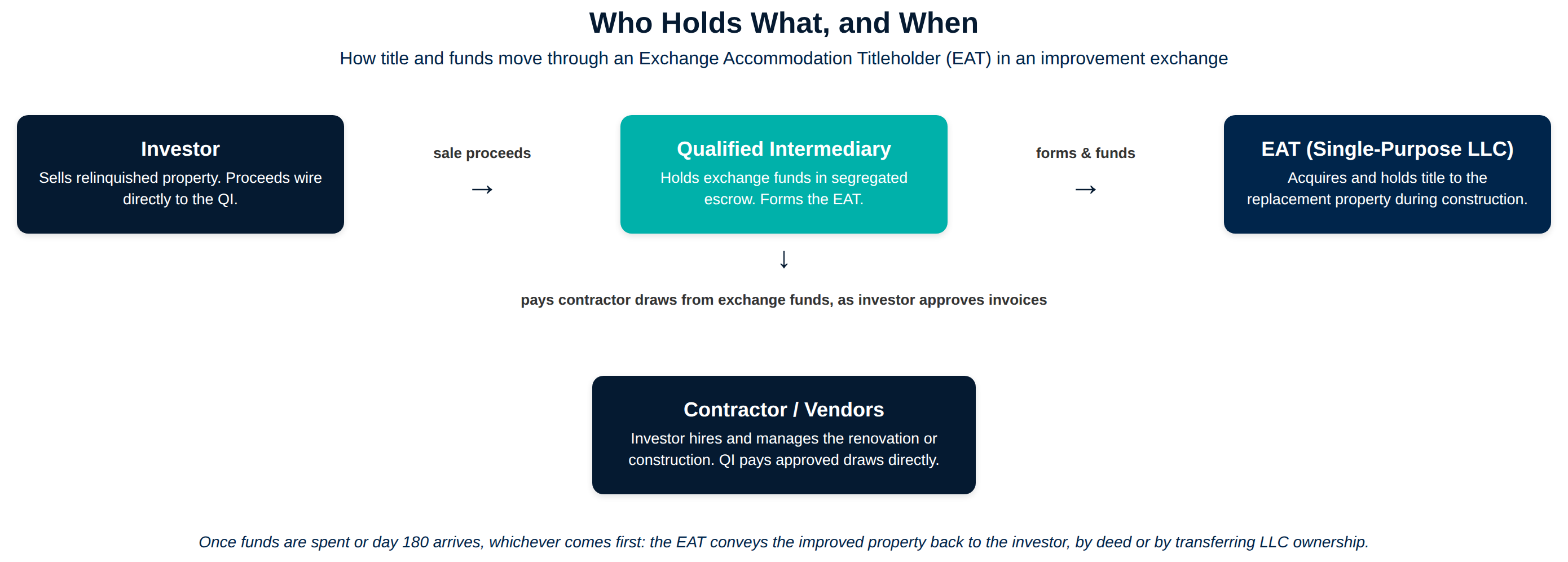
Once you've identified your replacement property and you're ready to close, we form a single-purpose LLC that acts as the EAT — not a shell company recycled from some prior deal, but one created specifically for your exchange. It won't hold any other assets or take on any other business before or after.
The EAT, not you, acquires the replacement property using your exchange funds and holds that title while construction happens. That's what lets your funds pay for capital improvements without jeopardizing your deferral. Meanwhile, you manage construction yourself — you hire your own general contractor and vendors, oversee the job site, and make the day-to-day decisions, just like you would on any other renovation.
Think like a home builder, not just a buyer. A builder doesn't pay for a lot and construction costs and then sell at breakeven; the builder prices in the value created by the work itself. An improvement exchange lets you capture that same kind of built-in equity, using dollars you'd otherwise send to the IRS. Seen that way, a rundown, underpriced property starts looking like an opportunity instead of a problem.
When invoices and draw requests come in from your contractors, you direct your QI to pay them out of your remaining exchange funds, similar to how a construction escrow works on a bank-financed project. We manage the money and paperwork behind the EAT, not the construction — that part's yours to run.
How Long the EAT Holds the Property
The EAT holds title for however long is left on your 180-day clock once the replacement property closes, since that clock started the day your original sale proceeds hit our account. If you used 20 days of your 45-day identification window before closing on the replacement property, you've got 160 days left for the EAT to hold title while your contractors work.
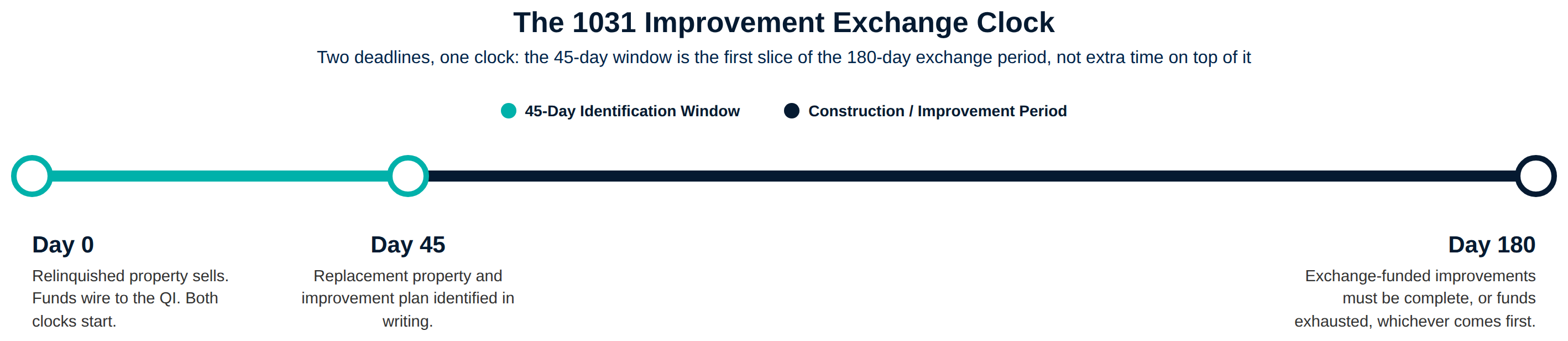
These are hard calendar-day deadlines. The deadline doesn't move. Contractors do. There's no extension for weekends, holidays, or a contractor who falls behind schedule, and the IRS doesn't grant extensions on request. Despite what you might read online, there's no separate 12-month deadline for improvement exchanges either. That myth gets repeated constantly in investor forums, but the only deadlines that matter are the same 45 and 180 days that apply to every deferred exchange.
One detail catches almost everyone off guard the first time: only the improvements actually paid for with your 1031 funds have to be finished within the 180-day window, not necessarily your entire construction project. If your renovation is bigger than what your exchange funds cover, you can keep building after the exchange closes using your own money or a construction loan. You just can't use exchange funds for anything completed after day 180.
Keep in mind what exchange funds can and can't pay for, too. They cover capital improvements: a new roof, a full remodel, ground-up construction, utility installation, road building. They cannot pay for furniture, fixtures, and equipment, because FF&E isn't an improvement to the real property itself. One client renovating a beach house called us partway through the project. He figured that since everything else in the house was getting redone, the new living room furniture should qualify too. It doesn't work that way. We could pay for the kitchen and bathroom remodel, but the furniture had to come out of pocket.
What Happens When the Exchange Closes
Your exchange closes the moment either your exchange funds run out or your 180 days expire, whichever happens first. At that point, the EAT needs to get the property into your hands, and there are two ways to do it.
The first is straightforward: the EAT deeds the property directly to you, just like a normal transfer of real estate. The second option is a little different, and it's the one a lot of our clients end up choosing. Instead of a deed, we transfer ownership of the LLC itself over to you. You end up owning the entity that owns the property, rather than owning the property in your own name.
Most investors haven't gotten around to setting up an LLC for liability protection on their own, and taking over the EAT hands them that structure already in place. It's a practical bonus, not the main reason to structure an exchange this way. Which route makes sense depends on your broader estate and liability planning. Consult your tax advisor for guidance specific to your situation.
Improvement Exchange vs. a Standard Deferred Exchange
Most investors' first 1031 exchange is a standard deferred exchange: sell, identify, buy, done. An improvement exchange adds a layer most QIs rarely touch, shown side by side below.
| Standard Deferred Exchange | Improvement Exchange | |
|---|---|---|
| Who holds title | You, at closing | The EAT (a single-purpose LLC), until the exchange closes |
| Can you build or renovate with exchange funds | No | Yes, within the 180-day window |
| Complexity | Familiar to most lenders and title companies | Requires an EAT, construction draws, and a lender comfortable with the structure |
| WealthBuilder 1031 flat fee | $1,000 | $6,500 |
EAT vs. Reverse Exchange: Are They the Same Thing?
Not quite, and this is where a lot of investors get their wires crossed. An EAT shows up in improvement exchanges, where you sell your relinquished property first and then use the EAT to hold and improve the replacement property with your exchange funds. That's the sequence we've walked through above.
A reverse exchange works differently. You buy the replacement property before you sell the one you're giving up, which means an EAT holds title to the property you already bought while you work on selling your old one. The EAT itself is the same tool in both cases; it's only the order of operations that changes. You can also combine the two into a reverse improvement exchange, where the EAT holds a newly acquired property while it's being improved before your relinquished property sale closes. That's a more complex structure reserved for specific situations, not the standard playbook for most investors.
Deferred exchanges make up roughly 94% of all 1031 exchanges nationwide, so improvement and reverse exchanges are the exception rather than the rule. That's part of why some lenders and title companies aren't fully comfortable with the EAT structure — it simply doesn't come up often enough for everyone at the closing table to have seen it before. We're WealthBuilder 1031, a nationwide qualified intermediary led by Chris Peterson, a licensed Texas real estate attorney.
A Real Improvement Exchange, Start to Finish
Numbers explain the mechanics. A story shows why investors bother. He wasn't looking to cash out and walk away — he wanted more doors and better cash flow, without giving up the equity he'd already built. Our client owned a small 12-unit apartment complex, more of a townhouse community than a typical apartment building, that he'd already fixed up, and he had a good offer in hand. The problem was everything he found at his sale price was either overpriced or already stabilized with no upside left.
He identified a 20-unit complex instead, in rougher shape and priced well below what a stabilized 20-unit property would normally cost. Using the same exchange funds he would have spent on a smaller, move-in-ready property, he closed through an EAT and directed us to pay out draws as his contractors brought the units up to standard, unit by unit. By the time the renovation wrapped, he'd grown from 12 doors to 20 on essentially the same equity and debt he'd carried before, and he raised rents roughly 50% over what the old property had produced. He deferred the capital gain and built new equity into the replacement property at the same time, something a straight trade into a stabilized 20-unit at full price never would have given him.
That's the case for thinking like a builder instead of a shopper. A rundown property that scares off a cash buyer can be exactly the opportunity an improvement exchange investor is looking for.
Is This Right for You?
This is a good fit if:
- You're having trouble finding a replacement property at or above your sale price and you're open to buying below-market and adding value instead
- You already have a renovation or new construction plan in mind, even in broad strokes, before your relinquished property closes
- You're comfortable managing a contractor relationship, or you already have one lined up
- You want the full value of your capital gain working for you instead of sitting as a partial exchange subject to tax
This probably isn't the right fit if:
- You need to close and be done within a few weeks with no construction involved
- You don't have a general contractor or renovation plan and don't want to build one before your 45-day identification deadline
- Your construction budget is so large relative to your exchange funds that a standard purchase with a separate construction loan, outside the exchange, makes more sense
- You're not willing to work with a QI experienced in improvement exchanges; this isn't a structure to learn on the fly with a QI who has never closed one
Frequently Asked Questions
Does the EAT ever become the permanent owner of my property?
No. The EAT holds title only temporarily, for the length of your exchange period, and transfers it to you, either by deed or by transferring LLC ownership, once your exchange closes or your funds run out, whichever comes first.
I thought lenders wouldn't finance a property titled to an LLC they don't control. How does that work?
Lenders get the same four protections they'd have in any LLC-owned deal: a promissory note signed by the EAT, a personal guarantee from you, a deed of trust allowing foreclosure, and a vendor's lien in the deed. The only real difference is that LLC ownership changes hands from the QI to you at the end of the exchange, and most lenders are comfortable with that once it's explained, since you're the one they're really underwriting.
I thought I had to already own the replacement property before I could improve it. Isn't that the whole point of the EAT?
That's exactly why the EAT exists. Revenue Procedure 2000-37 lets a separate entity, the EAT, hold title so your property stays "held for exchange" while improvements happen, which is what allows exchange funds to pay for construction before you personally take title.
What does an EAT cost?
At WealthBuilder 1031, improvement and reverse exchanges carry a flat $6,500 fee, compared to $1,000 for a standard deferred exchange, reflecting the extra legal work of forming the EAT, documenting the QEAA, and managing construction draws.
Can I use exchange funds to buy furniture or appliances for the replacement property?
No. Exchange funds can only pay for capital improvements to the real property itself, things like a new roof, remodeling, new construction, or utility installation. Furniture, fixtures, and equipment don't qualify, even during an active improvement exchange.
What happens if my construction project isn't finished by day 180?
Only the improvements paid for with your 1031 funds need to be complete by day 180; your broader construction project can continue afterward using your own funds or a construction loan. The exchange itself simply closes once your exchange funds are spent or the 180 days run out, whichever comes first.
Does every QI offer improvement exchanges?
No, and this is one of the more common surprises for investors. Improvement and reverse exchanges require specialized legal knowledge that not every QI works with regularly, so it's not unusual for us to take on referrals from firms that don't handle these structures.
Ready to Structure Your Improvement Exchange?
An exchange accommodation titleholder is the legal mechanism that lets you use 1031 exchange funds to improve a replacement property before you own it in your own name, and it works whether you're doing a standard improvement exchange or the acquisition side of a reverse exchange. Knowing how the EAT fits into your 45- and 180-day deadlines, and what your options are when the exchange closes, puts you in a position to plan a project instead of scrambling to understand one midstream. If you're weighing how an improvement exchange uses an EAT to hold title against your renovation timeline, or you want to understand what a qualified intermediary actually does behind the scenes, those are good next stops.
If you're planning an improvement exchange, WealthBuilder 1031 can help. We're a nationwide Qualified Intermediary with specific experience in improvement and reverse exchanges. Our accounts are segregated, insured, and bonded. Call 888-508-1901 or visit WealthBuilder1031.com to get started.
This article is for educational purposes only and does not constitute legal or tax advice. Consult your tax advisor or attorney regarding your specific situation.
Disclaimer: This content is for informational purposes only and does not constitute legal or tax advice. Consult your tax advisor or attorney for advice specific to your situation.

Chris Peterson — Texas Licensed Attorney & Founder, WealthBuilder 1031
Chris is the Owner and President of WealthBuilder 1031 and a licensed Texas attorney. He graduated from Wheaton College and the University of Texas School of Law and speaks regularly to realtors, accountants, and title companies about 1031 exchanges. Learn more →
Have Questions?
Chat with one of our team members to see if a 1031 Exchange is right for you, (without committing to anything).
Video Resources

Case Studies
August 14, 2026
Reverse Improvement Exchange: Combining 1031 Strategies
Most investors who call us about advanced 1031 strategies are wrestling with one complication, not two. Every so often, someone finds a replacement property that
Read More

August 11, 2026
How Realtors Add Value in a 1031 Improvement Exchange
The call almost always starts the same way. A client sold a property, the exchange funds are sitting with the qualified intermediary, and nothing on
Read More
August 7, 2026
Case Study: Turning 12 Units Into 20 With an Improvement Exchange
When he called us, our client wasn't looking for a bigger version of the 12-unit apartment complex he'd just agreed to sell. He was looking
Read More
Get Started Today
It is easy to get started on your exchange. You can either call our office directly at 888-508-1901, or you can fill out our Start Your Exchange form.
Start Your Exchange