

We've had this exact phone call more times than we can count. A client's loan officer hears that title to the replacement property will sit in a limited liability company the investor doesn't technically own yet, and there's a pause on the other end of the line, sometimes a long one. The loan officer starts asking questions that have nothing to do with credit scores or debt service coverage, and everything to do with "wait, who am I actually lending to here?"
We get it. A 1031 exchange lender who has never handled an improvement exchange is walking into paperwork that doesn't look familiar, and that makes lenders nervous. But once you strip away the exchange terminology, the loan looks almost identical to a standard commercial deal, and we can usually prove it in about ten minutes.
Key Takeaways
- An improvement exchange loan uses the same four protections as any commercial loan: a promissory note, personal guarantee, deed of trust, and vendor’s lien.
- The EAT, not the exchanger, is the entity on title and on the note — but the lender still underwrites the exchanger personally through the guarantee.
- Most lender hesitation comes from unfamiliarity with the EAT structure, not real added risk — a short explanation from your QI usually resolves it.
- Ownership of the EAT LLC transfers to the exchanger once the exchange closes; the loan itself typically doesn’t need to be refinanced.
- Loop your lender in early, ideally before listing the relinquished property, since first-time EAT financing can take extra explaining.
Why Lenders Get Confused by Improvement Exchanges
In a typical improvement exchange, also called a construction or build-to-suit exchange, you sell your relinquished property first. Your qualified intermediary sets up a special-purpose LLC, an Exchange Accommodation Titleholder or EAT, to hold title to the replacement property while contractors make improvements using your exchange funds. This structure comes from Revenue Procedure 2000-37, the IRS safe harbor that created the Qualified Exchange Accommodation Arrangement (QEAA) framework. Once the improvements wrap up and the 180-day window closes, ownership of the LLC transfers to you, and you own the improved property outright.
That arrangement satisfies the IRS. It can also throw a lender for a loop the first time they see it. A loan officer used to lending directly to the eventual owner gets nervous when the borrower on paper isn't the investor across the desk. Some lenders worry the LLC is a shell entity with no accountability behind it, and others just don't know what box to check on their underwriting worksheet.
None of that reaction is unreasonable. It's simply unfamiliarity. Most community and regional bank lenders see only a handful of 1031 exchanges a year, and improvement exchanges are a smaller slice still. Once you explain the mechanics clearly, the confusion clears up fast, because the loan structure underneath isn't different from what the bank underwrites every week.
What Every Lender Actually Cares About
Strip away the exchange terminology, and any commercial lender wants to know two things before writing a check: how do I get repaid, and if you don't pay, what's my recourse?
Every protection a bank builds into a commercial loan exists to answer one of those two questions, and that holds true in an improvement exchange too. The bank wants a clear source of repayment and a fallback if that source runs dry. That's the entire conversation, whether the borrower is an LLC you've owned for ten years or a temporary EAT your qualified intermediary set up three weeks ago.
Once a lender sees those two questions answered the same way here as in any other commercial deal, most of the anxiety in the room disappears. What's unfamiliar to them is the entity holding title. What actually matters to their underwriting doesn't change at all.
The Spicy Properties Story: A Lender Example That Makes This Click
We use this example on nearly every lender call, because it's not hypothetical: a few years back, one of our own attorneys and his wife bought a commercial office building through an LLC named after their dog, Spicy. The building is owned by Spicy Properties LLC, and the two of them are its members.
When they went to the bank for financing, Spicy had a problem. She's a dog. No credit history, no income, no balance sheet. The bank wasn't actually lending to Spicy at all. It was lending to the two humans standing behind her, and the loan documents reflected that reality with four separate protections.
The LLC signed a promissory note promising to repay the loan. He and his wife each signed a personal guarantee, so the bank wasn't relying on a thinly capitalized LLC alone. The bank recorded a deed of trust, giving it the right to foreclose if payments stopped. And a vendor's lien went into the deed, putting the world on notice the property was mortgaged, so the bank stayed protected if Spicy Properties LLC tried to sell.
Four documents: note, guarantee, deed of trust, vendor's lien. Same four, every time. That's every commercial real estate loan we've seen, and it's exactly what a lender gets in an improvement exchange too. Nothing shrinks and nothing goes missing just because the LLC on the title happens to be temporary.
Promissory Note, Personal Guarantee, Deed of Trust, Vendor's Lien: The Four Protections in Both Deals
| Protection | Standard commercial loan (Spicy Properties LLC) | Improvement exchange loan (EAT LLC) |
|---|---|---|
| Promissory note | Signed by the owner-controlled LLC | Signed by the EAT LLC |
| Personal guarantee | Signed by the LLC's owners | Signed by the exchanger |
| Deed of trust | Recorded against the property | Recorded against the property |
| Vendor's lien | Recorded in the deed | Recorded in the deed |
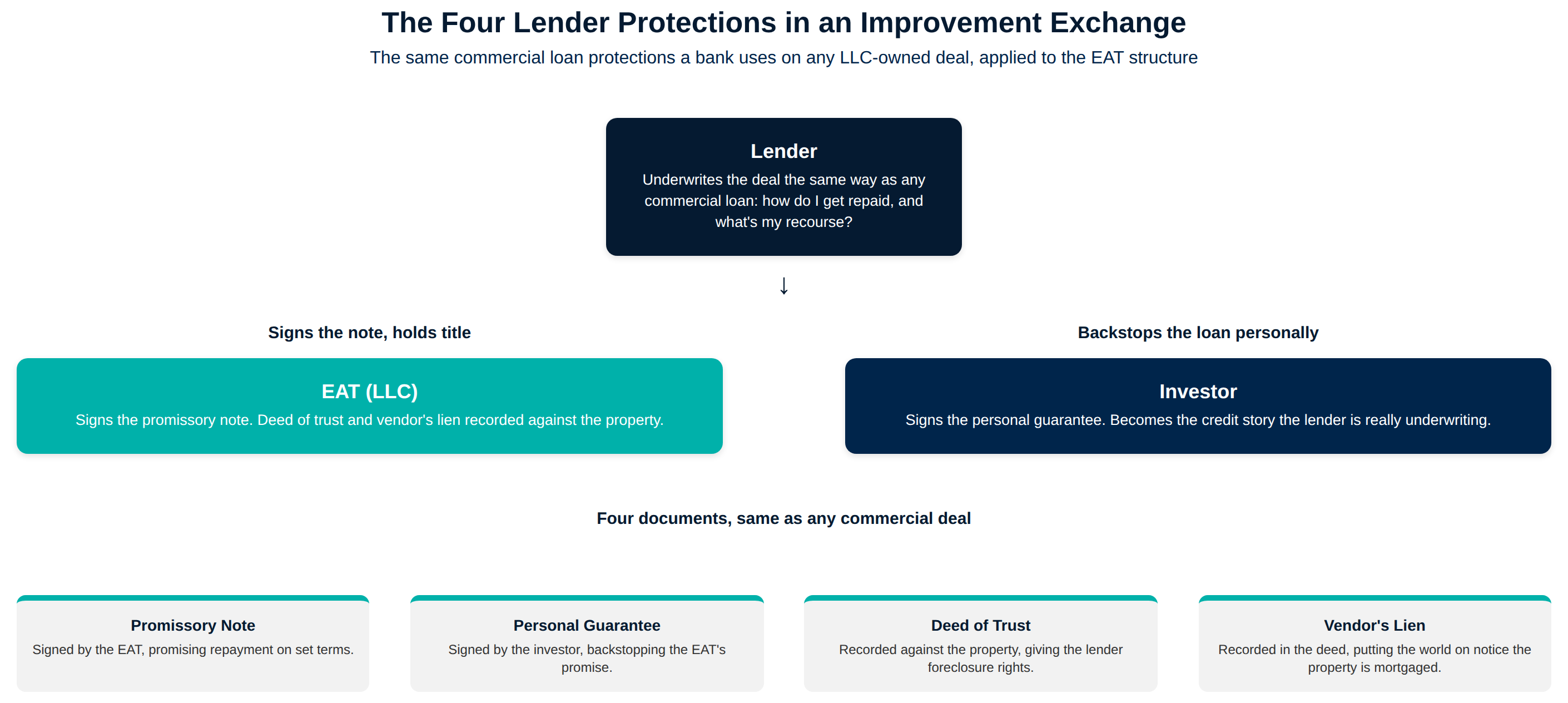
The only genuine difference between the two columns shows up at the finish line, not during the loan term. When the exchange closes and the EAT transfers the LLC membership interest to the exchanger, ownership changes hands, but the loan itself doesn't need to be reworked or refinanced. Most lenders are comfortable with that because the exchanger was the person they underwrote from day one. The EAT was never the real credit story. The bank sometimes adds a simple assumption or consent provision to acknowledge the change, and your qualified intermediary's attorney can coordinate that language with the bank's counsel before closing.
Only the portion of the improvements paid for with 1031 exchange funds has to finish within the 180-day window. If a construction loan is covering the rest of a bigger project, that loan-funded work can continue past day 180. The deadline applies to the exchange, not the construction timeline, so a lender-financed project doesn't have to race the clock the way the exchange itself does. The 180 days doesn't move. Your contractor's timeline can.
Common Lender Objections (And How We Handle Them)
These come up on almost every call.
"My lender said they won't lend to an LLC they don't control."
This objection usually comes from a loan officer who hasn't seen the personal guarantee yet. The bank isn't lending blind to an LLC it has no relationship with; it's lending to an entity backed by a personal guarantee from the exchanger, the same structure it already uses on ordinary LLC-held loans. Once that piece clicks, most lenders drop this objection on the spot.
"I thought I'd need to personally hold title to get financing."
You don't, and trying to force that outcome would break the exchange. The IRS safe harbor under Revenue Procedure 2000-37 requires the EAT to hold title during the improvement period, not you. What gets your name on the credit file isn't title, it's the personal guarantee and the deed of trust, both of which stay in place.
"Won't this slow down my closing?"
It can, but only if nobody talks to the lender until the week before closing. Getting your bank looped in early rarely costs meaningful time. We've had a closing nearly get derailed because nobody mentioned the EAT until the day before funding, and the loan officer needed a full day just to loop in the credit committee. Most delays happen when a client assumes their lender already understands improvement exchanges, then finds out otherwise with two weeks left on the identification clock.
Tips for Talking to Your Lender Before You Start
Loop your lender in early, ideally before you list the relinquished property. Improvement exchange financing takes more explaining than a standard purchase loan, and giving your bank time to get comfortable beats rushing them while your 45-day identification clock runs.
A few things make that conversation go smoother. Bring a one-page summary of the EAT structure, or have your qualified intermediary send one directly to the loan officer. Ask early whether the bank has handled a 1031 exchange loan before, since a first-timer may want a second look from their credit committee. Get preliminary loan approval lined up before the exchange clock starts, not after, so financing isn't a last-minute scramble alongside identification deadlines and escrow logistics.
Don't be shy about connecting your lender directly with your qualified intermediary either. A short call between the two of them, explaining the loan documents in plain terms, resolves more confusion than any back-and-forth routed through you as the middleman. We make that call regularly, and it's usually the single fastest way to get a hesitant lender to yes.
Will Your Lender Work With This Structure?
This is a good fit if:
- Your construction budget exceeds your leftover exchange funds, and you already have (or can qualify for) a commercial construction loan
- Your lender is willing to take a short call with your qualified intermediary about the EAT structure
- You're comfortable signing a personal guarantee, which you'd likely sign anyway on a normal LLC-held commercial loan
- You're bringing your lender into the process before you list your relinquished property, not after your 45-day clock starts
- You're working with a qualified intermediary who has actually walked lenders through this exact conversation before
This probably isn't the right fit if:
- Your lender flatly refuses to discuss financing against any entity it doesn't personally select, with no willingness to hear out the personal guarantee and deed of trust structure
- You're not willing to personally guarantee the loan under any circumstances
- Your financing needs to close in days with zero room to educate a first-time lender
- Your total improvement budget fits entirely inside your leftover 1031 funds, in which case you don't need a lender at all for this project
Frequently Asked Questions
Can a lender finance a 1031 improvement exchange?
Yes. Lenders finance improvement exchanges, and the loan uses the same four protections (promissory note, personal guarantee, deed of trust, and vendor's lien) as any standard commercial real estate loan.
Does my lender need to approve of the EAT structure?
Your lender doesn't need to approve the EAT itself, since the IRS requires it under Revenue Procedure 2000-37, but does need to understand how it works before underwriting the loan. A short explanation from your qualified intermediary usually covers it.
Do I still have to personally guarantee the loan if the EAT holds title?
Yes. You sign the personal guarantee just as you would through your own LLC, and that personal liability doesn't change because the entity on title is temporary.
Does the loan need to be refinanced when the EAT transfers title to me?
Generally no. The bank underwrote you as the credit story from the start, so the membership transfer is a formality, sometimes noted with a simple assumption or consent provision.
What if my lender has never handled a 1031 exchange loan before?
That's common, since improvement and reverse exchanges make up a small share of all exchanges. Give your lender extra lead time, provide a one-page summary of the structure, and connect them directly with your qualified intermediary.
Can I combine exchange funds with a construction loan?
Yes. Only the improvements paid for with exchange funds have to be completed within the 180-day window, and loan-funded construction can continue after that.
What types of improvements qualify for exchange funds?
Capital improvements added to the property, like a full remodel, new construction, utility installation, or road building, qualify. Furniture, fixtures, and equipment (FF&E) don't, so exchange funds can pay for a new kitchen but not the furniture that goes in it. Consult your tax advisor for specifics.
What does WealthBuilder 1031 charge for an improvement exchange?
We charge a flat $6,500 fee for improvement and reverse exchanges, which covers setting up and administering the EAT, coordinating with your lender and closing team, and managing your construction escrow through the 180-day period.
Own This Conversation Before Your Lender Does
An improvement exchange asks a lender to think about an unfamiliar structure, not take on unfamiliar risk. The bank still gets a note, a personal guarantee, a deed of trust, and a vendor's lien, the same four protections it wants on any commercial loan under Treasury Regulations Section 1.1031. Walk a lender through improvement exchange financing using that comparison, or let your qualified intermediary make the call directly, and most of the hesitation disappears before it becomes a closing delay.
WealthBuilder 1031, a nationwide qualified intermediary led by Chris Peterson, a licensed Texas real estate attorney, handles this lender conversation on improvement and reverse exchanges. We're attorney-owned, keep client funds in segregated escrow accounts, and are insured and bonded, all of which matters to lenders as much as it matters to you. We also take on complex deals that need extra structuring, and we're comfortable getting on the phone with your bank to make the case in terms their credit committee recognizes.
If you're planning an improvement exchange, call us before your lender starts asking questions you can't answer yet. Call 888-508-1901 or visit WealthBuilder1031.com to get started.
This article is for educational purposes only and does not constitute legal or tax advice. Consult your tax advisor or attorney regarding your specific situation.
Disclaimer: This content is for informational purposes only and does not constitute legal or tax advice. Consult your tax advisor or attorney for advice specific to your situation.

Chris Peterson — Texas Licensed Attorney & Founder, WealthBuilder 1031
Chris is the Owner and President of WealthBuilder 1031 and a licensed Texas attorney. He graduated from Wheaton College and the University of Texas School of Law and speaks regularly to realtors, accountants, and title companies about 1031 exchanges. Learn more →
Have Questions?
Chat with one of our team members to see if a 1031 Exchange is right for you, (without committing to anything).
Video Resources

Case Studies

August 14, 2026
Reverse Improvement Exchange: Combining 1031 Strategies
Most investors who call us about advanced 1031 strategies are wrestling with one complication, not two. Every so often, someone finds a replacement property that
Read More

August 11, 2026
How Realtors Add Value in a 1031 Improvement Exchange
The call almost always starts the same way. A client sold a property, the exchange funds are sitting with the qualified intermediary, and nothing on
Read More

August 7, 2026
Case Study: Turning 12 Units Into 20 With an Improvement Exchange
When he called us, our client wasn't looking for a bigger version of the 12-unit apartment complex he'd just agreed to sell. He was looking
Read More
Get Started Today
It is easy to get started on your exchange. You can either call our office directly at 888-508-1901, or you can fill out our Start Your Exchange form.
Start Your Exchange