
Sell a property for $500,000 in a market where nothing decent is listed at that price, and you're stuck. You either pay tax on whatever you can't reinvest, or you settle for a property you don't really want just to hit the number. We built a large part of our practice around a third option. A 1031 improvement exchange lets you buy a smaller, cheaper property below what you sold, then use the leftover exchange funds to renovate or build it into something worth more than the property you gave up. We've said for years that this is our favorite exchange type, and the reason is simple: it's the only 1031 strategy that actually creates equity instead of just protecting what you already have.
Most investors know the standard version of a 1031 exchange: sell one property, buy another of equal or greater value, defer the capital gains tax. An improvement exchange adds a step most people have never heard of. Exchange funds pay for construction or renovation before you ever take title, so the property you end up owning is worth more than what a straight swap would have gotten you. You become the developer of your own replacement property, and your exchange funds pay for the upgrade.
That flexibility is also what makes improvement exchanges one of the most misunderstood tools in the 1031 world. There's a QI, a temporary title holder, hard federal deadlines, and a construction budget, and all of it has to move in the right order. Get one step wrong and the whole exchange can unravel. For a broader look at when this strategy fits, see our 1031 improvement exchange overview.
Key Takeaways
- An improvement exchange lets you buy a less expensive replacement property and use leftover exchange funds to renovate or build it into something worth more.
- You must hire your QI and sign exchange paperwork before your relinquished property closes — there’s no retroactive fix.
- Sale proceeds wire to your QI, starting both the 45-day identification clock and the 180-day exchange clock at the same time.
- An Exchange Accommodation Titleholder (EAT) acquires the replacement property and holds title while your contractors do the work, funded through construction draws.
- Only the exchange-funded improvements need to be finished within 180 days — a larger project can continue afterward with your own funds or a construction loan.
Standard Exchange vs. Improvement Exchange
A standard deferred exchange and an improvement exchange share the same 45-day and 180-day deadlines, but the path through them looks different. The table below shows where they diverge.
| Step | Standard Deferred Exchange | Improvement Exchange |
|---|---|---|
| Who holds title to the replacement property | You, directly, at closing | An Exchange Accommodation Titleholder (EAT), temporarily |
| What exchange funds can pay for | Purchase price only | Purchase price plus capital improvements |
| Extra entity required | None | Single-purpose LLC formed by your QI |
| Typical use case | You can find a property at or above your sale price | You can't find a property worth what you sold, or want to build more value into it |
Step 1: Hire Your QI Before You Sell (This Is Non-Negotiable)
You have to hire your Qualified Intermediary and sign your exchange paperwork before your relinquished property closes, no exceptions. A QI is the neutral third party who holds your sale proceeds so you never touch the money directly, which is what keeps your gain eligible for tax deferral under Treasury Regulations Section 1.1031. If you close on your sale first and try to set up an exchange afterward, the exchange is dead. The IRS doesn't allow retroactive 1031 exchanges, and we've had to deliver that news to more than one investor who called us a week after closing thinking they still had time.
Your QI needs to line up the entity that will temporarily hold title to your replacement property, and setting that structure up correctly takes lead time. Read our guide on what a Qualified Intermediary actually does for the full rundown on this role.
We tell every client to call their QI the day they list the property, not after they get an offer. Waiting until the last minute is the single most common way an exchange gets disqualified before it even starts.
Step 2: Sell the Relinquished Property and Wire Proceeds to the QI
Once your exchange paperwork is signed, you close on the sale of your relinquished property like any normal transaction. The difference is where the money goes. Instead of landing in your bank account, the proceeds wire directly to your QI, who holds them in a segregated escrow account until you're ready to use them.
That wire transfer is the moment your exchange clock starts, and it starts two clocks at once. You get 45 days to identify potential replacement properties, and you get 180 days total to close out the entire exchange. Investors often assume the 45 days sits on top of the 180 as extra time. It doesn't. The 45-day identification window is the first slice of your 180-day clock, not an add-on.
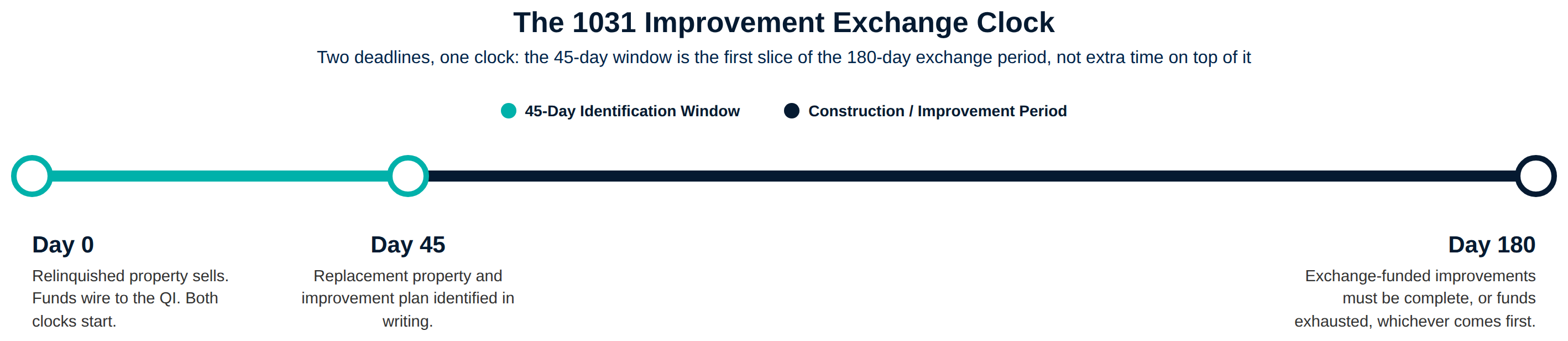
Both deadlines are hard calendar-day deadlines. They don't move. Not for weekends, holidays, or a contractor running behind. Mark both dates on your calendar the same day the wire goes out.
Step 3: Identify the Replacement Property and Improvement Plan Within 45 Days
Within 45 days of your sale closing, you give your QI a written list of potential replacement properties. You pick one of three identification rules to structure that list. You don't even need to tell your QI which one you're using; a quick look at the list makes it obvious.
| Rule | How Many Properties | Value Limit |
|---|---|---|
| Three-Property Rule | Up to 3 | No limit |
| 200% Rule | Unlimited | Combined value up to 200% of what you sold |
| 95% Rule | Unlimited | Must acquire 95% of what you list |
For an improvement exchange, you also submit a general improvement plan alongside your property identification. This doesn't need to be granular. You need a broad scope of work, not a paint-color-level spec sheet. We had a client send over his general contractor's outline the same week we recorded the webinar this article draws from: new roof, added square footage, a full remodel. That level of detail was exactly right. It told us what we needed to document the exchange without forcing him to lock in every material selection under deadline pressure.
Use this 45-day window to talk to your contractor about realistic timelines too. What you can actually finish within your remaining exchange period should shape how ambitious your improvement plan gets.
Step 4: The QI's EAT Acquires the Property and Funds Construction
An improvement exchange breaks from a standard deferred exchange right here: you don't buy the replacement property yourself. Your QI forms a single-purpose LLC called an Exchange Accommodation Titleholder, or EAT, and that entity uses your exchange funds to acquire the replacement property in its own name. The IRS authorized this structure, formally known as a Qualified Exchange Accommodation Arrangement (QEAA), under Revenue Procedure 2000-37, because the agency requires someone other than you to hold title while 1031 funds pay for improvements.
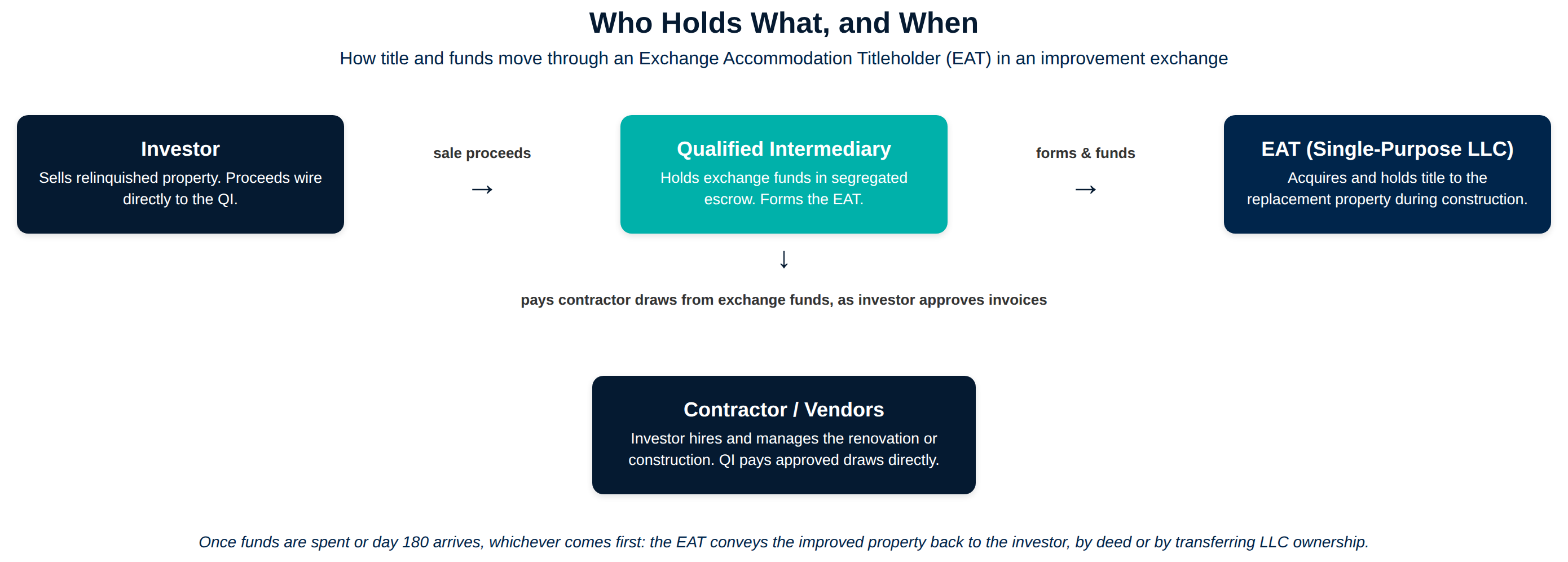
The EAT holds title temporarily while the work happens, but you're still the one running the job. You hire and manage your own contractors and vendors, and you direct your QI to pay their invoices and draw requests out of the remaining exchange funds. The EAT is a title-holding mechanism, not a construction manager. Your QI pays the bills, and you run the site.
This structure trips up a lot of lenders who haven't seen it before. Deferred exchanges make up roughly 94% of all 1031 exchanges nationwide, so improvement and reverse exchanges cross a typical loan officer's desk far less often. If you're financing part of your replacement property purchase, loop your lender in early. WealthBuilder 1031, a nationwide qualified intermediary led by Chris Peterson, a licensed Texas real estate attorney, can walk your bank through the EAT structure directly if their underwriting team has questions.
Step 5: Closing Out the Exchange Within 180 Days
Construction continues while the EAT holds title, and your QI keeps paying contractor draws out of the construction escrow until one of two things happens: you run out of exchange funds, or you hit day 180 from your original sale closing, whichever comes first. Only the improvements actually paid for with exchange funds need to be finished within that 180-day window, not necessarily your entire project if it's bigger than what the exchange funds cover.
That gives you room to work with. If your total renovation plan runs larger than your exchange budget, keep building after the exchange closes with your own funds or a construction loan.
Once you hit the funding limit or the 180-day mark, the exchange closes and title transfers to you, either by a deed from the EAT directly to you or by transferring ownership of the LLC itself. Many investors choose to keep the LLC in place after closing, since it gives them a layer of liability protection going forward without any extra setup work.
There's no such thing as a 12-month deadline for improvement exchanges. If you've heard that somewhere, it's a myth. The real deadline is 180 calendar days from your relinquished property's closing, full stop.
Real Investors, Real Improvement Exchanges
Numbers and deadlines only tell part of the story. Two exchanges we've worked on show what an improvement exchange actually does for a portfolio.
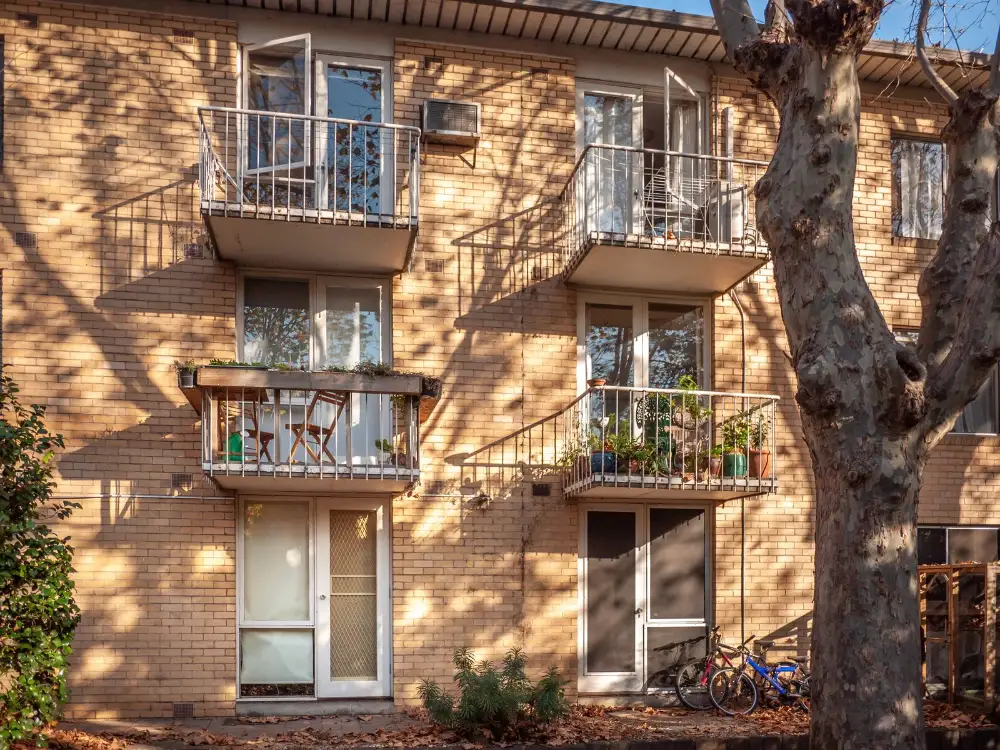
He wasn't chasing a bigger, flashier property. He wanted more doors without stepping outside the comfort zone he'd already built managing a small 12-unit apartment community, more of a townhouse feel than a typical complex, one he'd already fixed up with a strong offer in hand. Availability was the problem: most of the smaller multifamily properties in his target area were older, run-down class C buildings priced accordingly. He found a 20-unit complex that fit the profile and badly needed work, then used his sale proceeds and an improvement exchange to acquire it below its stabilized value and fund the renovation through the EAT. He came out the other side with roughly the same equity and debt load he started with, but close to double the units and rents that ran about 50% higher than what the 12-unit property produced, and he deferred his capital gains tax on top of it. Consult your tax advisor for guidance specific to your situation, since results depend on the deal, the market, and your own financial position.
The second client wasn't interested in trading one aging retail property for another. He owned a strip center built in the 1980s, still functional but getting more expensive to maintain every year, and he could see where that trend was headed. Instead of buying another tired retail center, he found a greenfield site in a newer, faster-growing part of town, with roads and basic infrastructure already in but nothing built yet. His exchange funds paid for the first phase of a ground-up development: engineering, architecture, site grading, foundation work, and extending utilities from the property line to each retail unit. A construction loan picked up the rest once the exchange funds ran out. He walked away from a depreciating asset in a shrinking submarket and into a newly built property in a growing one, funded in part with dollars that would otherwise have gone to the IRS.
Common Mistakes That Blow Up an Improvement Exchange Timeline
A handful of recurring problems show up again and again in improvement exchanges. Most are avoidable.
Lender confusion is the most common, for the reasons above, so get ahead of it by looping in your loan officer early. Missing the funded-improvement deadline is another frequent trap, since investors sometimes assume they have a full year or underestimate how long permitting and construction actually take. Only the exchange-funded improvements need to wrap up by day 180, so build your construction schedule around that number from day one, not your total project scope.
Spending exchange funds on ineligible items causes real headaches too. One client renovating a beach house called us halfway through the project, certain the new living room furniture could come out of exchange funds since everything else in the house was being redone. We could pay for the kitchen and bathroom remodel; the furniture had to come out of pocket, since furniture, fixtures, and equipment (FF&E) aren't improvements to the real property itself.
Working with a QI who doesn't regularly handle improvement exchanges is a risk on its own. These deals have more moving parts than a standard deferred exchange, and a QI who rarely sees this structure is more likely to miss a step. Ask any QI you're considering how many improvement exchanges they've actually closed before you hand over your sale proceeds.
Is This Right for You?
This is a good fit if:
- You sold a property and can't find a replacement at or above your sale price in your target market
- You want to build real value into a property using tax-deferred dollars instead of paying for improvements later out of pocket
- You're comfortable managing contractors and vendors, or already do that as part of your investment strategy
- Your improvement plan, or at least the exchange-funded portion of it, can realistically wrap up within your remaining 180-day window
- You're working with, or willing to work with, a QI who has actually closed improvement exchanges before
This probably isn't the right fit if:
- You already have a replacement property under contract at full value with no improvements planned (a standard deferred exchange is simpler and cheaper)
- Your construction timeline can't realistically get the exchange-funded portion done inside 180 days
- You don't want the added complexity of an EAT, a construction draw process, and coordinating with a lender
- You're not prepared to hire and manage your own contractors during the exchange period
Frequently Asked Questions
How much does a 1031 improvement exchange cost?
WealthBuilder 1031 charges a flat $6,500 fee for improvement and reverse exchanges, reflecting the extra work of forming and managing the EAT and administering construction draws. That's higher than our $1,000 fee for a standard deferred exchange, but it covers a meaningfully more complex transaction with more legal steps involved.
Do all my construction improvements have to be finished within 180 days?
No, only the portion paid for with your 1031 exchange funds has to be complete within the 180-day window. If your total project is bigger than your exchange funds, you can keep building afterward with your own money or a construction loan, as long as the exchange-funded work is substantially done by the deadline.
Will my lender finance a property that's titled to an LLC instead of me?
Yes, and lenders who understand the structure treat it much like any LLC-owned commercial deal. The EAT signs the promissory note, you sign a personal guarantee and a deed of trust, and the deed carries a vendor's lien, the same four protections a bank would require if you'd bought the property in an LLC of your own. The main difference is that ownership of the LLC transfers to you once the exchange closes.
Do I need a detailed construction plan for my 45-day identification?
No, a general scope of work is enough. Your QI needs to know the categories of work, such as a new roof, added square footage, or a full remodel, not a finalized set of construction drawings or paint colors.
What can 1031 exchange funds actually pay for during construction?
Exchange funds can pay for capital improvements, meaning permanent additions to the real property itself, such as new construction, a full remodel, utility installation, or major system replacements. They cannot pay for furniture, fixtures, and equipment (FF&E), since those items aren't considered improvements to the real property.
Is there really a 12-month deadline for improvement exchanges?
No, that's a common myth. The real deadline is 180 calendar days from your relinquished property's closing, the same as any other exchange type, and it doesn't extend for weekends or holidays.
Does every Qualified Intermediary handle improvement exchanges?
No, and this matters more than most investors realize. Improvement exchanges require forming and administering an EAT, structuring a QEAA under Revenue Procedure 2000-37, and managing construction draws. Not every QI takes these deals on, so ask how many they've actually closed before you commit your sale proceeds.
Can I identify a replacement property before I have it under contract?
Yes, your 45-day identification list doesn't require a signed contract. You just need enough detail, an address, legal description, or parcel number, to tell your QI which properties you might buy and what improvements you might make.
Ready to Build Real Equity Into Your Next Property?
An improvement exchange rewards preparation more than any other exchange type. Hire your QI first, sell and wire your proceeds, identify your property and improvement plan within 45 days, let the EAT hold title while you run construction, and close everything out within 180 days. Every deadline is fixed, every dollar has to go toward a real capital improvement, and the margin for error shrinks the longer you wait to get organized.
We've closed improvement exchanges on everything from a 12-unit apartment community to a ground-up retail development, and we've never told a client their project was too complicated to structure correctly. We're insured, bonded, and we hold every client's funds in a segregated escrow account. If you're weighing an improvement exchange, or you're not even sure yet whether it's the right move, call us at 888-508-1901 or visit WealthBuilder1031.com before you sign a listing agreement. The earlier we're involved, the more options you keep on the table.
This article is for educational purposes only and does not constitute legal or tax advice. Consult your tax advisor or attorney regarding your specific situation.
Disclaimer: This content is for informational purposes only and does not constitute legal or tax advice. Consult your tax advisor or attorney for advice specific to your situation.

Chris Peterson — Texas Licensed Attorney & Founder, WealthBuilder 1031
Chris is the Owner and President of WealthBuilder 1031 and a licensed Texas attorney. He graduated from Wheaton College and the University of Texas School of Law and speaks regularly to realtors, accountants, and title companies about 1031 exchanges. Learn more →
Have Questions?
Chat with one of our team members to see if a 1031 Exchange is right for you, (without committing to anything).
Video Resources

Case Studies
August 14, 2026
Reverse Improvement Exchange: Combining 1031 Strategies
Most investors who call us about advanced 1031 strategies are wrestling with one complication, not two. Every so often, someone finds a replacement property that
Read More

August 11, 2026
How Realtors Add Value in a 1031 Improvement Exchange
The call almost always starts the same way. A client sold a property, the exchange funds are sitting with the qualified intermediary, and nothing on
Read More
August 7, 2026
Case Study: Turning 12 Units Into 20 With an Improvement Exchange
When he called us, our client wasn't looking for a bigger version of the 12-unit apartment complex he'd just agreed to sell. He was looking
Read More
Get Started Today
It is easy to get started on your exchange. You can either call our office directly at 888-508-1901, or you can fill out our Start Your Exchange form.
Start Your Exchange