
Real estate investors ask this question all the time, usually right after they've found a great piece of land or sat through a builder's pitch on a ground-up development deal. The short answer is yes: a 1031 exchange for new construction is absolutely possible, but only if you set it up correctly from day one. Get the structure wrong, and you'll blow your tax deferral entirely.
Improvement exchanges close on everything from beach house remodels to full ground-up retail centers. This post walks through exactly how investors use exchange funds to build new property instead of buying something that already exists, using a real client deal as the roadmap.
Key Takeaways
- A standard 1031 exchange can’t fund new construction, but an improvement exchange can, using the same EAT structure authorized by Revenue Procedure 2000-37.
- The EAT takes title to the land or property and pays contractors, architects, and suppliers directly out of exchange funds as work is completed.
- Only the cost of the improvements counts toward your replacement value — not the market value those improvements create, which is where real equity gets built.
- Only the exchange-funded portion of construction has to be done within 180 days; a larger build can continue afterward with a separate construction loan.
- Exchange funds cover capital improvements like foundation, framing, and utilities, but not furniture, fixtures, or equipment.
Short Answer: Yes, With the Right Structure
In plain English: a standard 1031 exchange cannot fund new construction, but a specialized version called an improvement exchange can. You sell your relinquished property, and instead of buying an existing building with the proceeds, you use those dollars to build one from the ground up.
The catch is timing and structure. You can't sell your property, sit on the cash, and go hire a contractor on your own terms. The IRS has specific rules about who holds title during construction and how the money moves, rules that trace back to Revenue Procedure 2000-37, the safe harbor that created what's known as a Qualified Exchange Accommodation Arrangement, or QEAA. An 1031 improvement exchange is built around that safe harbor, and it's the only legitimate path to using exchange funds for a construction project.
Some investors flip that order in their head: buy the land or building first, then sell the old property later. That's a different structure entirely, a reverse exchange, and it runs on its own rules.
Why a Regular 1031 Exchange Doesn't Work for Ground-Up Construction
A standard deferred exchange assumes you're swapping one finished property for another finished property. Treasury Regulations Section 1.1031 requires you to acquire like-kind real property within your exchange period, and in a plain-vanilla exchange that means closing on something that already exists and is ready to go the day you take title. There's no mechanism in that structure for paying a contractor, buying materials, or covering months of site work.
The problem gets worse once you consider what "acquiring" property actually means for tax purposes. If you buy raw land and spend exchange funds building on it after closing, the IRS doesn't count that construction spending toward your exchange value. Only the value of what you've actually acquired by the time you take title counts. Dirt with a building permit isn't the same as a finished retail center, and treating it that way turns a tax-deferred sale into a fully taxable one fast. That's why investors who want new construction need a different vehicle, one built to hold property in a kind of legal escrow while dollars turn into brick and mortar.
How an Improvement Exchange Makes New Construction Possible
An improvement exchange, sometimes called a build-to-suit or construction exchange, solves the timing problem with a structure the IRS has recognized since 2000. You still sell your relinquished property first, exactly like a normal exchange. Your exchange funds wire to your qualified intermediary, not to you directly, and that wire is what starts your clock.
The QI forms an Exchange Accommodation Titleholder, an EAT for short, a single-purpose LLC that takes title to the land or replacement property on your behalf. That entity holds title while construction happens, and it pays contractors, architects, and suppliers directly out of your exchange funds using invoices and draw requests you approve. You never touch the money, and you don't hold title yourself until construction wraps up, or your funds run out, and the deal transfers into your name.
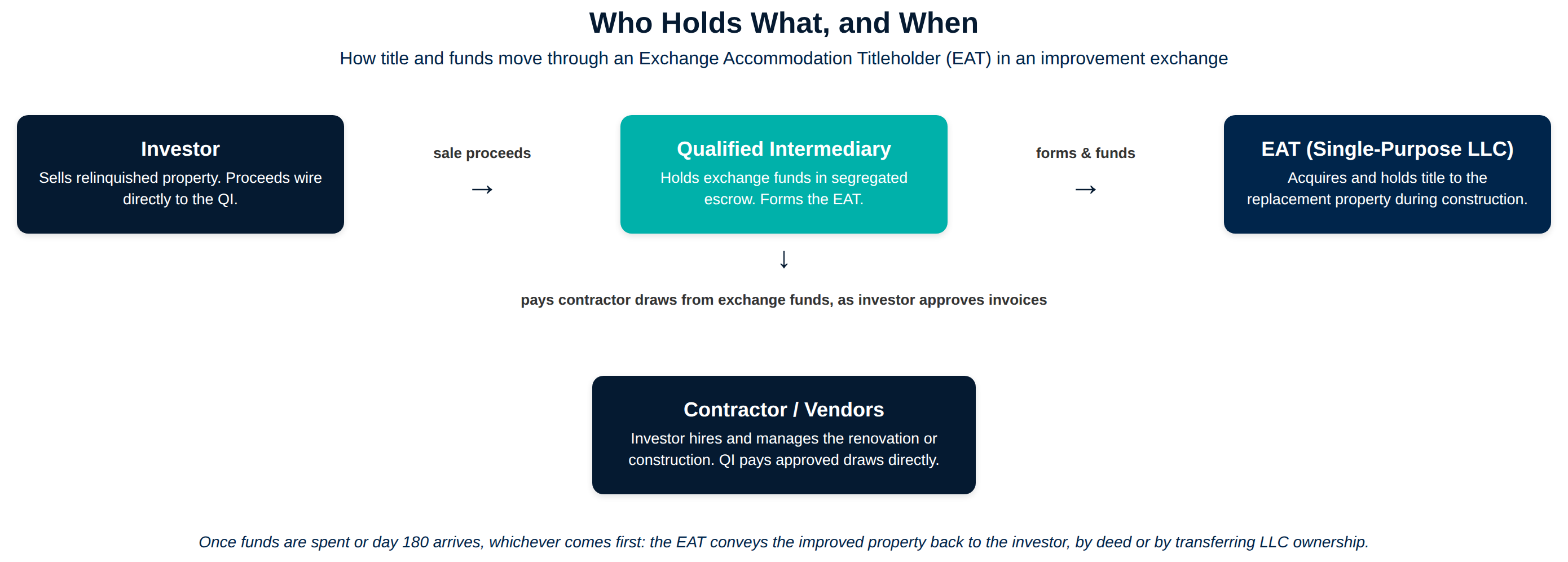
This structure lets the IRS treat the finished, or partially finished, improvements as part of what you "acquired," instead of treating construction spending as separate from the exchange. Without that titleholder entity standing in the middle, none of your construction costs would count toward your replacement property value. At the end, you can take title by straight deed, or take over the LLC itself, which a lot of our clients prefer since it hands them liability protection they hadn't gotten around to setting up.
Not every QI is comfortable running this kind of deal — the EAT paperwork, construction draws, and lender coordination are specialized work that not every intermediary handles regularly. WealthBuilder 1031, a nationwide qualified intermediary led by Chris Peterson, a licensed Texas real estate attorney, takes on these deals because we have that infrastructure. We hold exchange funds in segregated escrow accounts, we're insured and bonded, and improvement exchanges are a meaningful part of what we do daily, not an occasional special request.
Case Study: An Aging Strip Center Becomes a Ground-Up Retail Development
When he first called, our client wasn't chasing a bigger footprint or a flashier address. He was tired of pouring money into a building that kept asking for more than it gave back. He owned a strip retail center built in the 1980s that had done its job for decades, but by the time he came to us it had turned into a maintenance treadmill: a roof that needed patching every year, electrical systems that were starting to worry his insurance carrier, and tenants asking for upgrades he didn't want to keep funding in a part of town that wasn't growing anymore. He wasn't looking to leave retail, just that specific property.
We structured an improvement exchange so he could sell the strip center and put the proceeds toward a greenfield site in a fast-growing suburban corridor instead of shopping for another finished retail building. The site had roads in and basic utility lines run to the property boundary, and nothing else, just a location with real growth behind it.
His exchange funds covered the first phase of turning that potential into a real asset: engineering and architecture fees, site grading and development, pouring the foundation, and extending utilities, water, sewer, electrical, cable and phone, from the property line out to each individual retail unit. Utility companies typically stop service at the edge of the lot, so building out water and power lines to every unit inside the property is real, fundable construction work, exactly the kind of cost an improvement exchange is built to handle.
Once his exchange dollars ran out, he didn't stop building. He picked up a separate construction loan and finished the project on its own schedule, completely outside the exchange rules. The EAT's loan documents already gave his lender the same four protections it would want in any commercial deal: a promissory note signed by the EAT LLC, a personal guarantee from our client, a deed of trust, and a vendor's lien in the deed. The lender never took on unfamiliar risk just because a QI was involved. He ended up trading an aging, high-upkeep property in a stagnant part of town for a new, better-performing asset in a growing one, and he deferred the capital gains tax the entire way through. Consult your tax advisor for guidance specific to your situation, since basis and gain calculations differ for every investor.
The 45-Day and 180-Day Clock Still Rules Everything
The standard exchange deadlines apply here, and they don't loosen up just because a building has to go up instead of just closing on one. You have 45 days from your sale to identify your replacement property in writing, and 180 days total, starting the day your sale closes and funds, to finish your exchange. Those are hard calendar deadlines with no extensions, and the IRS doesn't care if day 180 falls on a Sunday or on Christmas. The date doesn't move. Construction schedules do.
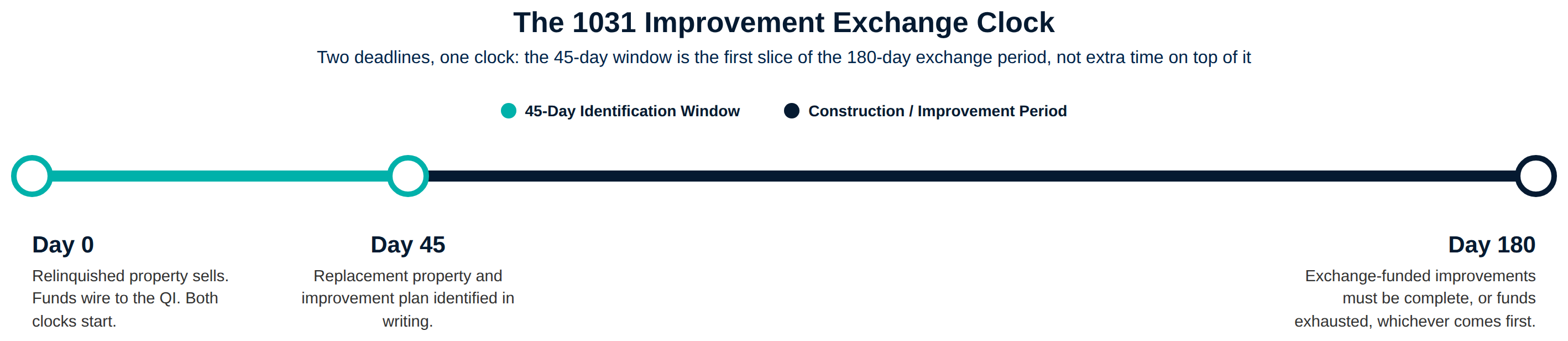
In an improvement exchange, that 45-day identification list does double duty. You're not only telling us the address of the property you might buy, you're also giving us a general list of the improvements you plan to make. We don't need paint colors, just confirmation that framing, utility work, or a full build is coming. Most of our clients identify under the three-property rule or the 200% rule rather than the stricter 95% rule, which effectively commits you to buying almost everything on your list.
The tension investors feel is real: construction takes months, and 180 days goes fast once permits, weather, and subcontractor schedules get involved. The next section is why that tension usually works itself out.
You Don't Need the Whole Project Finished by Day 180
This surprises most investors, and it's good news. Only the portion of construction actually paid for with your 1031 exchange funds has to be complete by day 180, not the entire project. If your build is bigger than your exchange funds can cover, and plenty are, you bring in a separate construction loan to finish the rest, and that loan runs on its own schedule, completely disconnected from your exchange deadline.
Think of it like a home builder's math. Say a builder buys a lot for $200,000 and puts $450,000 into construction, labor and materials included. He's got $650,000 total invested, but he doesn't sell that finished house for $650,000 and call it a win — he sells it for $950,000, because that extra $300,000 is what building, not just buying, is worth. The tax code works the same way for you: it only counts the cost of your improvements toward your replacement property value, not the market value those improvements create. Put $100,000 of exchange funds into improvements that raise a property's value by $300,000, and you only need $100,000 of replacement value to satisfy your exchange, but you walk away holding the full $300,000 in equity. That gap between cost and value is where an improvement exchange builds real wealth.
Not everything you spend during construction qualifies, though. Exchange funds cover capital improvements added directly to the property: framing, roofing, utilities, a complete new build, a road cut into raw land. They can't pay for furniture, fixtures, or equipment. One client midway through a beach house remodel called and asked us to wire funds for a new living room set. We had to explain that furniture doesn't qualify as a capital improvement, even though the kitchen remodel two rooms over did.
Renovation vs. Ground-Up Construction Within an Improvement Exchange
| Factor | Renovating an Existing Property | Ground-Up New Construction |
|---|---|---|
| Who holds title during work | EAT (LLC) holds title until improvements are done or funds run out | EAT (LLC) holds raw land or a shell, often for a longer stretch |
| Timeline pressure | Lower; most renovation scopes fit inside 180 days | Higher; site work, permitting, and vertical construction rarely finish in 180 days |
| Complexity | Moderate; fewer permitting layers, faster draws | Higher; engineering, utility extensions, and lender coordination all stack up |
| Typical funding mix | Exchange funds often cover the full scope | Exchange funds usually cover the first phase, with a construction loan finishing the rest |
| When it makes sense | You like the location but the building is dated or undersized | You've found a stronger location or asset type and are willing to build to get it |
Is This Right for You?
This is a good fit if:
- You've sold, or are about to sell, an investment property and want to defer the capital gains tax
- You've found a location or asset type you like better than what's on the market at your price point
- You're comfortable managing a contractor relationship, or already have a builder you trust
- Your exchange-funded construction phase can realistically wrap up within 180 days of closing
- You're open to a construction loan finishing a project that's bigger than your exchange funds alone
This probably isn't the right fit if:
- You need a fully finished, move-in-ready property right away
- You haven't lined up a builder or contractor and won't have time to before your 45-day identification deadline
- Your only goal is the smallest possible replacement purchase; this structure works best when you want to build real value
- You're not willing to work with a QI experienced in EAT structures and lender coordination
Frequently Asked Questions
Can I really finish an entire new building in 180 days?
Usually not, and you don't have to. Only the improvements paid for with 1031 exchange funds need to be complete by day 180. Larger projects use exchange funds for the first phase, engineering, site work, foundation, and finish the rest with a separate construction loan on its own timeline.
Do I need a certificate of occupancy by day 180?
No. The exchange rules care about how your exchange dollars were spent by day 180, not whether the building has passed final inspection. A property can still be under active construction when title transfers back to you, as long as the exchange-funded work is finished and paid for.
What happens to unfinished construction value at day 180?
Once day 180 arrives, or your exchange funds run out, whichever comes first, the exchange closes and the property, or the EAT's LLC membership, transfers to you. Construction beyond that point continues under your ownership, typically funded by your own capital or a construction loan, and it's no longer part of the 1031 transaction.
What does an improvement exchange cost?
We charge a flat $6,500 fee for improvement and reverse exchanges, reflecting the extra legal work involved in setting up and administering the Exchange Accommodation Titleholder. That's different from the fee on a standard deferred exchange, which is a simpler transaction to run.
Can I use a lender or construction loan alongside my exchange funds?
Yes, and it's common on larger projects. Lenders sometimes have questions about loaning to an EAT LLC rather than to you directly, but the same protections they'd want in any commercial deal, a note, a personal guarantee, a deed of trust, and a vendor's lien, are still in place.
Does this work for any property type, or just retail and commercial?
It works for any property held for trade, business, or investment use, from single-family rentals to raw land. The property you sell and the property you build don't need to match in type, since all real estate is like-kind to all other real estate under Section 1031.
What if I don't spend all my exchange funds on construction?
Any exchange funds left over at day 180 become taxable, the same as cash boot in any exchange. We build the improvement schedule and draw timeline with clients before their identification deadline so exchange dollars get fully deployed.
Ready to Build With Your Exchange Funds?
New construction and 1031 exchanges work together well, as long as you use the improvement exchange structure and respect the same 45- and 180-day deadlines that govern every exchange. The EAT does the heavy lifting, holding your replacement property while your exchange dollars fund real, measurable construction progress. Get the structure right from the start, and you can trade an aging, underperforming property for something built exactly the way you want it, tax deferral intact.
If you're planning an improvement exchange, WealthBuilder 1031 can help. We're a nationwide qualified intermediary experienced in improvement and reverse exchanges, including complex builds that take more hands-on structuring. Call 888-508-1901 or visit WealthBuilder1031.com to get started.
This article is for educational purposes only and does not constitute legal or tax advice. Consult your tax advisor or attorney regarding your specific situation.
Disclaimer: This content is for informational purposes only and does not constitute legal or tax advice. Consult your tax advisor or attorney for advice specific to your situation.

Chris Peterson — Texas Licensed Attorney & Founder, WealthBuilder 1031
Chris is the Owner and President of WealthBuilder 1031 and a licensed Texas attorney. He graduated from Wheaton College and the University of Texas School of Law and speaks regularly to realtors, accountants, and title companies about 1031 exchanges. Learn more →
Have Questions?
Chat with one of our team members to see if a 1031 Exchange is right for you, (without committing to anything).
Video Resources

Case Studies
August 14, 2026
Reverse Improvement Exchange: Combining 1031 Strategies
Most investors who call us about advanced 1031 strategies are wrestling with one complication, not two. Every so often, someone finds a replacement property that
Read More

August 11, 2026
How Realtors Add Value in a 1031 Improvement Exchange
The call almost always starts the same way. A client sold a property, the exchange funds are sitting with the qualified intermediary, and nothing on
Read More
August 7, 2026
Case Study: Turning 12 Units Into 20 With an Improvement Exchange
When he called us, our client wasn't looking for a bigger version of the 12-unit apartment complex he'd just agreed to sell. He was looking
Read More
Get Started Today
It is easy to get started on your exchange. You can either call our office directly at 888-508-1901, or you can fill out our Start Your Exchange form.
Start Your Exchange