
Most investors who call us have the same story. They sold a property, they've got proceeds sitting with us as their qualified intermediary, and they're stuck hunting for a replacement that actually excites them. In a tight market, that hunt turns frustrating fast. Good inventory is scarce, sellers know it, and everything decent is priced at a premium. We watch investors get boxed in by a rule they think is rigid: sell one property, buy another one that already exists, and hope it's good enough.
Instead of asking "what can you afford to buy," we ask "what could you build?" That's the moment an improvement exchange stops being a technical footnote in the tax code and starts feeling like a strategy the investor didn't know they had access to.
An improvement exchange, sometimes called a construction exchange or a build-to-suit exchange, lets you use 1031 proceeds to buy a property and then improve, renovate, or build on it, all inside one tax-deferred exchange. You're not settling for whatever happens to be on the market. You're creating the asset you actually want, the same way a professional home builder does, and you get to defer tax on every dollar of value you add in the process.
Key Takeaways
- An improvement exchange lets you act like a builder — acquiring a property and adding value through construction — instead of just buying whatever’s already on the market.
- The math works like new-home construction: your cost is your cost, but the value you create above that cost becomes real, tax-deferred equity.
- One client used this strategy to grow a 12-unit apartment property into a renovated 20-unit property on the same equity and debt, raising rents roughly 50%.
- The same 45-day identification and 180-day completion deadlines apply, with an EAT holding title while the improvements happen.
- This strategy fits investors comfortable managing a renovation or construction project — not those who want a simple like-for-like swap.
The Mindset Shift: You're Not Buying a Property, You're Building One
When you do a standard 1031 exchange, you sell a property and buy another one that already exists. You're a buyer, plain and simple, competing with every other buyer for the same finished inventory. An improvement exchange puts you in a different seat entirely.
You still sell your relinquished property first and roll the proceeds into the exchange, same as any 1031. But instead of purchasing something comparable and calling it done, you direct part of those funds toward acquiring a property and part toward improving it. Maybe that means renovating a dated apartment building, adding units to a small complex, or constructing new space on raw land.
In an improvement exchange, you stop competing for finished inventory and start acting like a home builder who acquires land, adds value through construction, and walks away with an asset worth more than what went into it. That shift changes how investors evaluate deals. A buyer asks what they can afford to purchase. A builder asks what they can create and what that creation will be worth once it's finished. That second question opens up a lot more opportunity, especially in markets where good replacement properties are scarce or overpriced.
The Math: $200K Lot + $450K Construction = $950K Sale
Consider the numbers a home builder deals with every day. A builder buys a vacant lot for $200,000, then spends another $450,000 on construction, materials, and labor to put a house on it. Add those two numbers together and the total cost sits at $650,000.
The builder doesn't sell the finished house for $650,000 just to break even. They list it for $950,000, and buyers pay it. The $300,000 gap between what the builder spent and what the house sells for isn't a markup pulled out of thin air. It's the value the builder created.
That value came from turning a mostly worthless lot into a finished, livable home. The builder managed the permits, coordinated the trades, made design decisions, and absorbed the risk that something could go wrong along the way: weather delays, cost overruns, a subcontractor who doesn't show up. The market rewards all of that with real dollars.
This is the exact math sitting underneath every improvement exchange we handle. When you acquire a property and improve it with exchange funds, you're doing what that builder does. The only difference is you're doing it with 1031 proceeds instead of your own bank account, and the value you create rides along tax-deferred with your original gain.
A Deal We've Watched Play Out: 12 Units Become 20
Numbers on a page are one thing. Watching a client actually run this play is another, and it's the kind of story that makes the strategy click for people who are still on the fence.
When he came to us, he wasn't chasing a bigger version of what he already owned. He wanted more doors, more cash flow, and a way to diversify, and he wasn't going to get there by waiting for the perfect listing. He owned a small, well-kept twelve-unit apartment community, and once he sold it and the proceeds landed with us as his qualified intermediary, the market gave him the same answer it was giving everyone else: clean, turnkey twelve-to-twenty-unit properties were hard to find, and the ones available were priced for buyers who wanted to do nothing but collect rent.
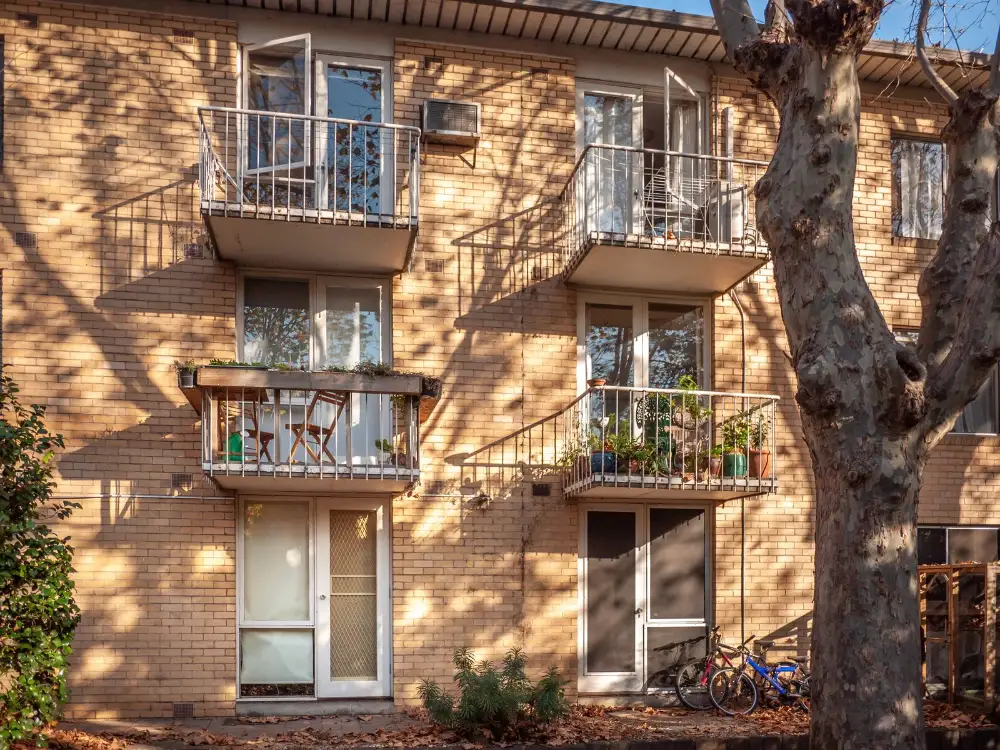
What he found instead was a twenty-unit property in rough shape, priced well below what his clean building would have cost. On paper, it looked like a downgrade. In practice, it was the better deal: he used the leftover exchange funds to renovate the property up to the standard of the one he'd sold, ending up with the same equity and the same debt load he carried before, plus eight more doors. Once the renovation was finished, he raised rents roughly 50 percent above where they'd been, because the property finally matched what tenants in that market were willing to pay for.
It's a pattern that surprises investors who assume 1031 rules only allow a straight swap. He needed exchange funds already sitting with us, redirected from a purchase price into a purchase price plus a renovation budget. The tax deferral worked exactly the same as any other exchange; the equity he built on top of it is what most investors don't realize is available until they see it done.
We've run a similar playbook for ground-up construction, too, moving a client out of an aging 1980s strip center and into new construction on a raw parcel, with exchange funds covering the first phase of site work and construction before a lender took over the rest.
Why That Profit Is Fair Payment for Your Time, Effort, and Risk
Some investors feel a little uneasy about that $300,000 gap in our builder example, like it's somehow unearned. It isn't. The builder fronted $650,000 in cash and credit, put weeks or months of his own time into managing the project, and accepted the risk that the finished house might not sell for what he hoped, or that costs might run over budget before the first buyer ever walked through the door.
Profit from construction and improvement work is compensation for capital at risk, hands-on effort, and specialized knowledge, not a windfall. A general contractor who builds a spec home and sells it for more than his costs isn't gaming the system. He's getting paid for a job well done, the same way an attorney gets paid for legal work or a broker earns a commission.
The same logic applies when you use an improvement exchange to renovate a rundown fourplex or build out a commercial space. You're taking on a project, managing contractors or hiring a general contractor to do it for you, and creating a finished asset worth more than your acquisition cost plus your construction cost. The equity you generate above your total investment reflects the work and risk you put in, not an accounting trick.
Is this riskier than buying something finished? Yes—there's more for you to manage than a simple purchase, and that's exactly why the reward exists. A finished property has already had its risk priced out by whoever built or renovated it before you bought it. An improvement exchange lets you capture that value instead of paying it to someone else, in exchange for taking on the coordination work yourself or handing it to a general contractor you trust.
How an Improvement Exchange Works: From Sale to Deed
The tax code that makes all of this possible is Internal Revenue Code Section 1031 and the Treasury Regulations under Section 1.1031, and improvement exchanges specifically rely on guidance the IRS issued in Revenue Procedure 2000-37, which authorized the use of a Qualified Exchange Accommodation Arrangement, or QEAA. That's the legal structure behind everything described below. Consult your tax advisor for guidance specific to your situation, since every exchange has its own facts.
A 1031 exchange lets you defer capital gains tax on the sale of investment property, as long as you reinvest your net proceeds into replacement property of equal or greater value. An improvement exchange gives you a way to hit that value requirement even when you can't find a replacement property expensive enough to absorb all your exchange funds on its own. You buy something less expensive instead, and put the leftover exchange funds toward capital improvements — the cost of those improvements counts toward your replacement value requirement.
The process runs in a specific order. You sell your relinquished property first, the same as any exchange, and the sale proceeds come to us as your qualified intermediary. That closing starts two clocks running at once.
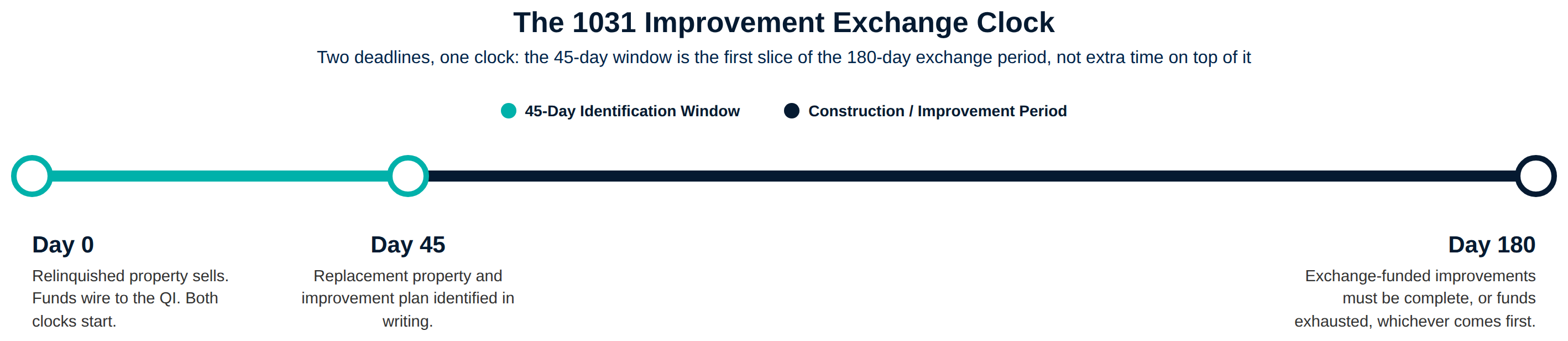
Within 45 days, you identify the replacement property and give us a list of the improvements you plan to make, in broad terms, paint, roof, new units, whatever applies. Within 180 days total, every dollar of exchange funds earmarked for the purchase and the improvements has to be spent. Both deadlines are hard stops set by the IRS. No extensions. No exceptions. The improvements that matter for your exchange are the ones completed and paid for inside that window, not necessarily your entire finished project if it's a multi-phase build.
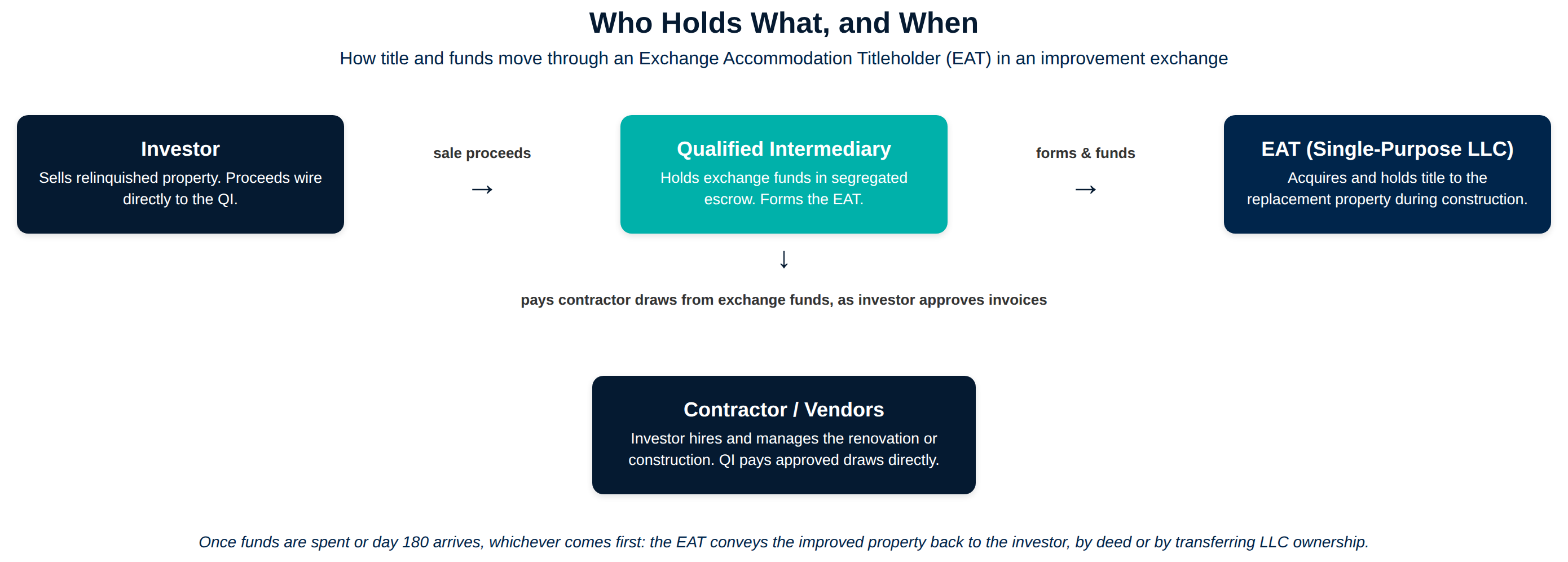
To make this legally possible, a special-purpose entity called an Exchange Accommodation Titleholder, or EAT, is formed for your transaction, typically a single-purpose LLC. The EAT temporarily holds title to the replacement property while the improvement work happens. Construction funds move through what functions as a construction escrow: you approve invoices, and your contractors and vendors are paid directly out of your exchange account, draw by draw, the same way a bank would fund a construction loan.
Running that structure correctly takes legal fluency most standard purchase transactions never require. WealthBuilder 1031, a nationwide qualified intermediary led by Chris Peterson, a licensed Texas real estate attorney, handles improvement and reverse exchanges every week — specialized work not every QI takes on regularly, since it requires the legal background to manage the EAT paperwork correctly.
Once your funds are spent or the 180-day deadline arrives, whichever comes first, the property comes back to you, either by deed or by transfer of the LLC itself. Many clients choose the LLC route because it hands them liability protection they hadn't set up on their own. Either way, you walk away holding the full benefit of an improvement exchange strategy that's fully yours, improved, and tax-deferred.
One detail trips people up: exchange funds can only pay for capital improvements, not furniture, fixtures, and equipment. We had a client midway through a renovation call wanting to wire funds for new living room furniture, since the rest of the unit was already getting redone. We had to explain that furniture doesn't count, even though the kitchen two doors down did. New kitchens, bathroom remodels, roofs, additions, and new construction all qualify. Furniture doesn't.
Buying a Finished Property vs. Building Your Replacement Property
Both paths get you a qualifying replacement property and a deferred tax bill. They don't get you the same outcome.
| Buying Finished | Building or Improving | |
|---|---|---|
| Equity position | Whatever the seller already priced in | Equity you create yourself through the work |
| Upside potential | Limited to market appreciation | Market appreciation plus the value you add |
| Complexity | Low, closer to a standard purchase | Higher, involves contractors, draws, and deadlines |
| Control over outcome | Minimal, you take the property as-is | Significant, you shape the finished asset |
Neither column is the "right" answer for every investor.
Is This Right for You?
This strategy isn't universal, and it doesn't need to be. Some investors are built for it, and some aren't, and both answers are fine.
This is a good fit if:
- You're comfortable managing a renovation or construction project, or you already have a general contractor you trust to run one for you.
- You've found, or can picture, a property with real upside: good bones in a great location, or raw land in a growing area where new construction makes sense.
- Your last few property searches left you unable to find anything at full value, and you'd rather create equity than keep waiting for the "right" listing to show up.
- You want to defer tax on your original gain and build additional equity on top of it in the same transaction.
This probably isn't the right fit if:
- You want a clean like-for-like swap: sell one rental, buy a similar rental, and move on with your life.
- The idea of coordinating permits, inspections, and a construction timeline sounds stressful rather than exciting.
- You're on a tight closing timeline and don't have room in your 180 days for a construction phase.
- You don't have a contractor relationship in place and aren't interested in building one before your exchange starts.
The investors who get the most out of this strategy tend to already think like builders in some way. They enjoy creating value, not just holding an asset and waiting for it to appreciate. If that's not you, a standard deferred exchange is simpler, and there's nothing wrong with wanting simplicity.
Frequently Asked Questions
What exactly counts as an improvement for 1031 exchange purposes?
Any capital improvement added directly to the real property qualifies: new construction, additions, renovations, roofs, electrical and plumbing upgrades, site work, and utility installation. Furniture, fixtures, and equipment, sometimes called FF&E, don't qualify, so exchange funds can pay for a new kitchen but not the appliances or furniture that go inside it.
I'm not a contractor. How would I actually manage the construction?
You don't have to swing a hammer or read blueprints to run an improvement exchange. Most clients hire a general contractor to manage the day-to-day work and simply approve invoices as they come in, the same way you'd oversee any renovation on a property you already owned.
What happens if construction costs run over budget?
Only the improvements paid for with exchange funds within your 180-day window count toward your exchange, so a larger or delayed project isn't automatically a problem. Clients with bigger builds often use exchange funds for the first phase of construction and finish the rest with a construction loan or their own capital after the exchange period ends.
Who holds title to the property while it's being improved?
A qualified intermediary sets up a special-purpose entity called an Exchange Accommodation Titleholder, or EAT, usually a single-purpose LLC, and it holds temporary title during the improvement period under a Qualified Exchange Accommodation Arrangement authorized by Revenue Procedure 2000-37. Once your funds are spent or your 180 days are up, title transfers to you by deed or by handing over ownership of the LLC itself.
How much does an improvement exchange cost?
WealthBuilder 1031 charges a flat $6,500 fee for improvement and reverse exchanges, reflecting the extra structuring work involved in setting up and managing an EAT. That's a flat fee, not a percentage of your transaction, so it doesn't grow with the size of your deal.
Can I use a lender or construction loan alongside my exchange funds?
Yes, and it's common on larger projects where the construction budget exceeds available exchange funds. Lenders sometimes need a short explanation of the EAT structure since it's less familiar than a standard purchase, but the loan documents work essentially the same way they would in any other real estate deal.
Does the finished property have to match my original property in value?
No, it has to match or exceed your net sale proceeds in combined acquisition and improvement cost, not any specific value target tied to your prior property. If you sell for $650,000 and reinvest $650,000 between the purchase price and completed improvements, you've met your reinvestment requirement.
Build Your Next Exchange Instead of Just Buying It
An improvement exchange gives you a different way to grow your real estate portfolio. Instead of trading one property for another, you get to act like a builder, acquiring an asset and creating additional value through improvements, while deferring tax on the gain from your original sale. The math works the same way it does for any builder: your cost is your cost, but what you create above that cost becomes real, deferred equity. Consult your tax advisor for guidance specific to your situation before you commit to a construction timeline against a 180-day deadline.
If you're weighing an improvement exchange, WealthBuilder 1031 can help. We're a nationwide Qualified Intermediary experienced in improvement and reverse exchanges, backed by segregated escrow accounts and insurance and bonding on every transaction. Call 888-508-1901 or visit WealthBuilder1031.com to get started.
This article is for educational purposes only and does not constitute legal or tax advice. Consult your tax advisor or attorney regarding your specific situation.
Disclaimer: This content is for informational purposes only and does not constitute legal or tax advice. Consult your tax advisor or attorney for advice specific to your situation.

Chris Peterson — Texas Licensed Attorney & Founder, WealthBuilder 1031
Chris is the Owner and President of WealthBuilder 1031 and a licensed Texas attorney. He graduated from Wheaton College and the University of Texas School of Law and speaks regularly to realtors, accountants, and title companies about 1031 exchanges. Learn more →
Have Questions?
Chat with one of our team members to see if a 1031 Exchange is right for you, (without committing to anything).
Video Resources

Case Studies
August 14, 2026
Reverse Improvement Exchange: Combining 1031 Strategies
Most investors who call us about advanced 1031 strategies are wrestling with one complication, not two. Every so often, someone finds a replacement property that
Read More

August 11, 2026
How Realtors Add Value in a 1031 Improvement Exchange
The call almost always starts the same way. A client sold a property, the exchange funds are sitting with the qualified intermediary, and nothing on
Read More
August 7, 2026
Case Study: Turning 12 Units Into 20 With an Improvement Exchange
When he called us, our client wasn't looking for a bigger version of the 12-unit apartment complex he'd just agreed to sell. He was looking
Read More
Get Started Today
It is easy to get started on your exchange. You can either call our office directly at 888-508-1901, or you can fill out our Start Your Exchange form.
Start Your Exchange